
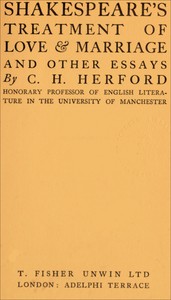
Shakespeare's treatment of love & marriage, and other essays
Written by C. H. (Charles Harold) Herford
Chaptra reads alongside you — AI insights, chapter breakdowns and reader discussions for every book. Join free
About this book
Reading guide
Themes, characters and key ideas in Shakespeare's treatment of love & marriage, and other essays, written by Chaptra AI.
- about 8 hours
- advanced
- scholarly
- analytical
- academic
C. H. Herford's "Shakespeare's Treatment of Love & Marriage, and Other Essays" is a foundational work of early 20th-century literary criticism, specifically examining the nuanced portrayal of romantic relationships in Shakespeare's plays. Herford posits that Shakespeare consistently favors a 'normal' and balanced form of love, characterized by a harmonious blend of passion, intellect, and morality, which naturally culminates in marriage. The collection explores how these ideals are presented across Shakespearean comedies and tragedies, contrasting them with other forms of love that lead to dramatic or tragic consequences. Beyond the central theme, the essays also delve into the broader influences on poetic creation, offering a comprehensive look at the playwright's thematic concerns and artistic methods.
“Shakespeare's ideal form of love is one that naturally leads to marriage, characterized by a balance of passion, intellect, and morality.”
Key themes
- Ideal Love Leading to Marriage
- This is the central theme, arguing that Shakespeare consistently portrays an ideal form of love characterized by equilibrium between emotion, reason, and moral integrity, which naturally culminates in the institution of marriage. Herford explores how this ideal is presented as the most stable and fulfilling form of romantic relationship.
- The Nuances of Romantic Relationships
- Beyond the ideal, Herford delves into the spectrum of romantic relationships in Shakespeare, acknowledging their complexities, challenges, and varied outcomes. This theme explores how love can be passionate, intellectual, moral, or a combination, and how these different facets contribute to the dramatic arc of Shakespeare's plays.
- Influence on Poetic Creation
- This theme, likely explored in the 'other essays,' examines the various factors that shape a poet's creative output. It moves beyond specific thematic analysis to consider the broader context of artistic inspiration, historical influences, philosophical underpinnings, and the playwright's personal worldview that inform Shakespeare's works.
Worth discussing
How does Herford's definition of 'normal' love and its connection to marriage reflect the societal values of his time (early 20th century)?
Chapter-by-chapter breakdowns, character arcs and the full thematic analysis come with a free account.
Discussions
No one has started one yet
Questions this book opens up
No discussions yet
Be the first to start a discussion about this book!
Sign up to start the discussionReviews
No reviews yet
Be the first to review this book!