
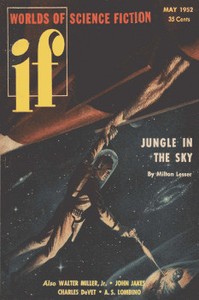
Welcome, Martians!
Written by Evan Hunter
Chaptra reads alongside you — AI insights, chapter breakdowns and reader discussions for every book. Join free
About this book
Reading guide
Themes, characters and key ideas in Welcome, Martians!, written by Chaptra AI.
- about 8 hours
- intermediate
- mysterious
- thought-provoking
- humorous
Evan Hunter's (writing as S. A. Lombino) "Welcome, Martians!" is a thought-provoking science fiction short story from the early 1950s that blurs the lines of identity and reality. It follows two Earth astronauts, Cal Manners and Dave Langley, as they become the first humans to land on Mars, only to be met with an astonishing case of mistaken identity. The Martian inhabitants, led by Mayor Panley, insist the astronauts are their long-lost heroes, Bobby Galus and Gary Dale, who supposedly returned after a four-year space journey. This persistent misunderstanding forces Cal and Dave, and by extension the reader, to question the nature of truth, cultural perception, and the uncanny possibility of parallel evolution between worlds, culminating in an intriguing twist that challenges their very sense of self.
“"We're Cal Manners and Dave Langley! From Earth! The first men on Mars!"”
Key themes
- Identity and Misperception
- The central theme revolves around the struggle of Cal and Dave to assert their true identities against the Martians' unwavering misperception. It explores how identity can be challenged, redefined, or even erased by external collective belief, forcing the protagonists to question who they truly are when their self-perception is entirely disregarded. The story posits that identity is not just an internal construct but also a social one, vulnerable to the narratives imposed upon it.
- Cultural Parallelism and Parallel Evolution
- This theme delves into the uncanny similarities between Earth and Martian culture, specifically the existence of 'Bobby Galus and Gary Dale' and their four-year journey. It raises profound questions about cosmic determinism, the likelihood of similar evolutionary paths across different planets, or the possibility of shared underlying cosmic patterns. The story uses this parallelism as its core mystery, suggesting that the universe might be more interconnected or cyclical than we imagine.
- The Nature of Reality and Subjectivity of Truth
- As the Martians refuse to acknowledge Cal and Dave's truth, the story forces a confrontation with the idea that reality might not be an objective, universally agreed-upon fact. Instead, it explores how truth can be subjective, shaped by collective belief, cultural context, and deeply held convictions. The astronauts' descent into questioning their own sanity highlights the fragility of individual truth when confronted by an overwhelming, unwavering alternative 'reality.'
Worth discussing
How does the story challenge our understanding of identity? Can identity be imposed or is it solely internal?
Chapter-by-chapter breakdowns, character arcs and the full thematic analysis come with a free account.
Discussions
No one has started one yet
Questions this book opens up
No discussions yet
Be the first to start a discussion about this book!
Sign up to start the discussionReviews
No reviews yet
Be the first to review this book!