
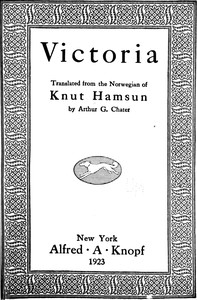
Victoria
Written by Knut Hamsun
Chaptra reads alongside you — AI insights, chapter breakdowns and reader discussions for every book. Join free
About this book
Reading guide
Themes, characters and key ideas in Victoria, written by Chaptra AI.
- about 5 hours
- intermediate
- melancholic
- romantic
- poignant
Knut Hamsun's "Victoria" is a poignant and melancholic novel chronicling the tragic, unrequited love between Johannes, a miller's son, and Victoria, the daughter of a wealthy castle owner. Set against the backdrop of late 19th-century Norwegian society, the story explores the insurmountable class barriers that separate the young lovers, despite their deep affection. As Johannes ascends socially through his literary ambition and Victoria faces familial pressures, their paths diverge and intertwine with heartbreaking consequences, ultimately leading to sacrifice and profound sorrow. The narrative is a masterclass in psychological realism and lyrical prose, delving into the complexities of human emotion, destiny, and the bittersweet nature of longing.
“Love is like a butterfly; it goes where it pleases and it pleases where it goes.”
Key themes
- Unrequited Love and Sacrifice
- The central theme, exploring the profound and often painful nature of love that is either unreturned, misunderstood, or obstructed by external forces. Both Johannes and Victoria make significant sacrifices—Victoria for her family's honor and Johannes for his ambition and ultimate understanding of their fate—highlighting the bittersweet and tragic aspects of their affection.
- Social Class and Ambition
- The novel vividly portrays the rigid social stratification of the late 19th century and its profound impact on individual lives and relationships. The class difference between Johannes, the miller's son, and Victoria, the castle owner's daughter, acts as an almost insurmountable barrier. Johannes's ambition to become a poet is partially fueled by his desire to bridge this gap, but ultimately, the societal structures prove too powerful.
- Nature and Spirituality
- Hamsun's characteristic deep connection between human emotion and the natural world is prominent. Nature often mirrors the characters' internal states, providing solace, inspiration, or reflecting their despair. Johannes, in particular, has a mystical connection to the environment, seeing it as alive and communicative, which underscores his sensitive and poetic soul.
Worth discussing
How do societal class structures and expectations influence the decisions and fates of Johannes and Victoria?
Chapter-by-chapter breakdowns, character arcs and the full thematic analysis come with a free account.
Discussions
No one has started one yet
Questions this book opens up
No discussions yet
Be the first to start a discussion about this book!
Sign up to start the discussionReviews
No reviews yet
Be the first to review this book!