
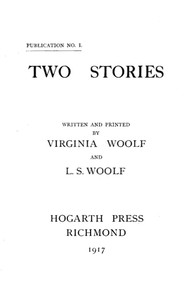
Two Stories
Written by Virginia Woolf,Leonard Woolf
Chaptra reads alongside you — AI insights, chapter breakdowns and reader discussions for every book. Join free
About this book
Reading guide
Themes, characters and key ideas in Two Stories, written by Chaptra AI.
- about 8 hours
- advanced
- introspective
- philosophical
- contemplative
"Two Stories" is a seminal collection featuring early works by Virginia and Leonard Woolf, showcasing the nascent stages of modernist literature. Comprising Leonard Woolf's "Three Jews" and Virginia Woolf's "The Mark on the Wall," the book explores profound themes of identity, perception, and the human condition. Leonard's narrative delves into an encounter that probes belonging, heritage, and the tension between tradition and modernity through a nuanced dialogue. Virginia's piece, a masterful stream of consciousness, uses a simple wall mark to launch a philosophical exploration of reality, societal constructs, and existential ponderings, challenging conventional narrative structures. Together, these stories offer a rich, introspective journey into the subjective realities and social commentaries prevalent in the early 20th century.
“"It is strange how a thing like a mark on a wall can have such power."”
Key themes
- Perception vs. Reality
- This theme is central to 'The Mark on the Wall,' where the narrator's elaborate imaginings about a simple mark highlight how subjective perception can create entire realities. The story questions the nature of objective truth and emphasizes the mind's power to construct meaning from ambiguity. It explores how our internal worlds shape our understanding of the external.
- Identity and Belonging
- Predominantly explored in 'Three Jews,' this theme delves into the complexities of cultural, religious, and personal identity. The Jewish man grapples with his heritage, the historical weight of his people, and his place within a society that may not fully accept him. It examines the tension between adhering to tradition and adapting to modernity, and the psychological impact of feeling 'othered.'
- The Nature of Existence and Time
- Virginia Woolf's 'The Mark on the Wall' is deeply preoccupied with existential questions about the meaning of life, the passage of time, and the ephemerality of human existence. The narrator's thoughts frequently drift to death, the insignificance of human endeavors in the grand scheme, and the subjective experience of time.
Worth discussing
How do both stories challenge traditional notions of plot and character development?
Chapter-by-chapter breakdowns, character arcs and the full thematic analysis come with a free account.
Discussions
No one has started one yet
Questions this book opens up
No discussions yet
Be the first to start a discussion about this book!
Sign up to start the discussionReviews
No reviews yet
Be the first to review this book!