
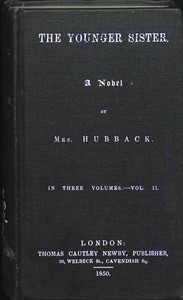
The Younger Sister: A Novel, Vol. II.
Written by Mrs. (Catherine-Anne Austen) Hubback
Chaptra reads alongside you — AI insights, chapter breakdowns and reader discussions for every book. Join free
About this book
Reading guide
Themes, characters and key ideas in The Younger Sister: A Novel, Vol. II., written by Chaptra AI.
- about 8 hours
- intermediate
- romantic
- social commentary
- introspective
Volume II of "The Younger Sister" by Mrs. Hubback delves into the intricate social landscape and romantic pursuits of the Watson sisters, Emma, Margaret, and Penelope, in mid-19th century England. As they prepare for a pivotal ball at Osborne Castle, the narrative explores themes of vanity, societal expectations, and intense sibling rivalry. Margaret grapples with insecurities about her appearance and status, while Penelope boldly seeks to elevate her standing among the elite. Emma, the more introspective sister, finds her perceptions challenged and her emotions stirred by an unexpected encounter with Sir William Gordon, setting the stage for deeper self-discovery and relational complexities amidst the pressures of high society.
“"The weight of expectation felt heavier than the finest silk, each stitch a judgment upon her worth."”
Key themes
- Societal Expectations & Status
- This theme explores the immense pressure placed upon individuals, particularly women, in 19th-century society to conform to specific social roles and achieve a certain status, often through advantageous marriage. The novel highlights how social events like the ball are battlegrounds for displaying wealth, beauty, and connections, determining one's place in the hierarchy.
- Vanity & Self-Perception
- The novel delves into the psychological impact of vanity and how it shapes characters' self-perception and interactions. Margaret, in particular, embodies this theme, constantly comparing herself to others and suffering from insecurity fueled by an overemphasis on external validation. This theme explores the fine line between self-awareness and self-obsession.
- Sibling Rivalry & Dynamics
- Central to the novel's title and premise, this theme explores the complex and often competitive relationships between the Watson sisters. Their differing personalities and aspirations lead to both overt and subtle rivalries, as well as moments of potential support or understanding, revealing the intricate bonds and tensions within a family.
Worth discussing
How do the different aspirations of Emma, Margaret, and Penelope reflect the limited choices available to women in the mid-19th century?
Chapter-by-chapter breakdowns, character arcs and the full thematic analysis come with a free account.
Discussions
No one has started one yet
Questions this book opens up
No discussions yet
Be the first to start a discussion about this book!
Sign up to start the discussionReviews
No reviews yet
Be the first to review this book!