
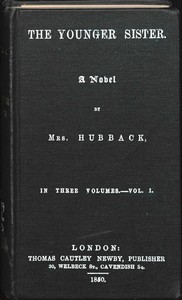
The Younger Sister: A Novel, Vol. I.
Written by Mrs. (Catherine-Anne Austen) Hubback
Chaptra reads alongside you — AI insights, chapter breakdowns and reader discussions for every book. Join free
About this book
Reading guide
Themes, characters and key ideas in The Younger Sister: A Novel, Vol. I., written by Chaptra AI.
- about 10 hours
- intermediate
- romantic
- social commentary
- domestic
Mrs. Hubback's "The Younger Sister: A Novel, Vol. I" is a mid-19th century domestic novel that introduces Emma Watson, the youngest daughter in a once-prosperous family now navigating reduced circumstances after her mother's death. The narrative explores the complex dynamics of family relationships, particularly Emma's return to a poorly managed household under an indolent father and her contrasting ambitions with an elder sister. As Emma grapples with societal expectations, familial loss, and the quest for connection, the novel sets the stage for her journey of self-discovery and the challenges of securing her place in a transforming social world. Her initial foray into society at a local ball serves as a catalyst for her burgeoning awareness of her desires and limitations, laying the groundwork for significant personal and relational conflicts. This first volume establishes the emotional landscape and social pressures that define Emma's early adulthood.
“"It was a truth universally acknowledged, though seldom spoken, that a daughter without a dowry was a burden to her father and an inconvenience to society."”
Key themes
- Social Status and Class
- The novel meticulously explores the intricacies of social status and class in 19th-century England, particularly the precarious position of a genteel family in decline. The Watson family's reduced circumstances after the mother's death and the father's indolence highlight the fragility of social standing and the intense pressure to maintain appearances. Emma's experiences, from her wealthy uncle's home to her own impoverished one, underscore the stark differences in opportunity and expectation based on one's position in society.
- Love, Marriage, and Financial Security
- As is typical for 19th-century novels, the institution of marriage is a primary focus, serving as both a romantic ideal and a crucial means of securing financial stability and social advancement for women. The novel contrasts Emma's desire for a marriage based on affection and understanding with her sister's more pragmatic approach, viewing marriage as an economic transaction. The pressures on young women to marry well are vividly portrayed, underscoring the limited options available to them.
- Family Duty and Relationships
- Central to Emma's journey is the complex web of family relationships and the varying interpretations of duty. The novel explores the impact of a negligent father and the burdens placed upon children, particularly daughters, to manage family affairs and secure their futures. The dynamic between Emma and her ambitious sister highlights the tension between individual desires and perceived familial obligations, especially concerning marriage and financial support.
Worth discussing
How does the novel portray the impact of financial instability on family dynamics and individual choices in the 19th century?
Chapter-by-chapter breakdowns, character arcs and the full thematic analysis come with a free account.
Discussions
No one has started one yet
Questions this book opens up
No discussions yet
Be the first to start a discussion about this book!
Sign up to start the discussionReviews
No reviews yet
Be the first to review this book!