
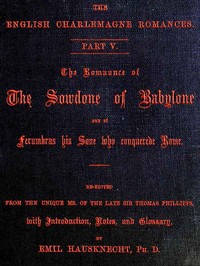
The Romaunce of the Sowdone of Babylone and of Ferumbras His Sone Who Conquerede Rome
Written by Unknown author
Chaptra reads alongside you — AI insights, chapter breakdowns and reader discussions for every book. Join free
About this book
Reading guide
Themes, characters and key ideas in The Romaunce of the Sowdone of Babylone and of Ferumbras His Sone Who Conquerede Rome, written by Chaptra AI.
- about 8 hours
- advanced
- epic
- chivalric
- adventurous
This Middle English romance, "The Romaunce of the Sowdone of Babylone and of Ferumbras His Sone Who Conquerede Rome," is a vibrant tale from the Charlemagne cycle, chronicling the epic conflict between Charlemagne's Christian forces and the Saracen empire led by the formidable Sultan Labane and his mighty son, Ferumbras. The narrative unfolds with the Saracen conquest of Rome and the theft of holy relics, prompting Charlemagne's paladins to embark on a perilous quest for their recovery. Central to the story is the dramatic conversion of Ferumbras, a powerful Saracen knight, to Christianity, alongside his resourceful sister Floripas, as they become instrumental in the Christian victory. The romance masterfully weaves themes of religious conflict, chivalric heroism, loyalty, and divine intervention through a series of grand battles, captures, and miraculous escapes.
“By Mahound, I swear, this day shall prove who is the better knight!”
Key themes
- Religious Conflict and Conversion
- This is the central theme, exploring the fundamental clash between Christianity and Islam as depicted in the medieval worldview. The narrative is driven by the Saracen desecration of Christian holy sites and the subsequent holy war. Crucially, it highlights the possibility and triumph of conversion, portraying it as a redemptive and miraculous act that ultimately resolves conflict and expands the Christian realm.
- Chivalry and Heroism
- The romance is a quintessential exploration of chivalric ideals. It showcases the virtues expected of knights: bravery in battle, loyalty to one's lord and faith, honor in combat, and steadfastness in adversity. Heroism is defined by martial prowess, adherence to a moral code, and willingness to sacrifice for higher ideals, particularly Christian faith.
- Loyalty and Treachery
- This theme is explored through the steadfast devotion of Charlemagne's paladins to their emperor and their faith, contrasted with the initial loyalty of Ferumbras and Floripas to their father, which they ultimately 'betray' for a higher loyalty to Christianity and personal conviction. Treachery is embodied by Sultan Labane's cruelty and broken promises, highlighting the moral divide between antagonists and protagonists.
Worth discussing
How does the romance portray the concept of chivalry, and how do both Christian and Saracen knights embody or defy these ideals?
Chapter-by-chapter breakdowns, character arcs and the full thematic analysis come with a free account.
Discussions
No one has started one yet
Questions this book opens up
No discussions yet
Be the first to start a discussion about this book!
Sign up to start the discussionReviews
No reviews yet
Be the first to review this book!