
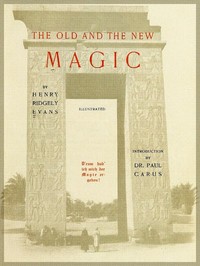
The Old and the New Magic
Written by Henry Ridgely Evans
Chaptra reads alongside you — AI insights, chapter breakdowns and reader discussions for every book. Join free
About this book
Reading guide
Themes, characters and key ideas in The Old and the New Magic, written by Chaptra AI.
- about 8 hours
- intermediate
- informative
- historical
- analytical
Henry Ridgely Evans's "The Old and the New Magic" is an early 20th-century historical account tracing the evolution of magic from its ancient, superstitious roots to its modern, scientifically-informed performances. The book's central thesis lies in contrasting "old magic," often intertwined with religious mysticism and belief in the supernatural, with "new magic," which leverages scientific principles, psychology, and elaborate stagecraft. An insightful introduction by Dr. Paul Carus establishes this dichotomy, exploring magic's etymological and historical ties to religion and superstition, thereby setting the stage for Evans's detailed examination of influential magicians and their transforming techniques throughout history. It provides a comprehensive look at how ancient practices have been reframed into the illusions we recognize today, highlighting the shift from genuine belief to artistic deception.
“"Magic, in its oldest sense, was an attempt to control the forces of nature through supernatural means, deeply intertwined with the spiritual beliefs of mankind."”
Key themes
- The Evolution of Magic: From Superstition to Science
- This is the central theme, exploring how magic transitioned from being perceived as supernatural intervention, often linked to religious or mystical beliefs ('old magic'), to a form of entertainment reliant on scientific principles, psychological misdirection, and ingenious stagecraft ('new magic'). The book details the historical trajectory of this transformation, showcasing how human understanding of the world influenced the practice and perception of illusion.
- The Nature of Belief and Illusion
- This theme delves into why humans are susceptible to illusion and the psychological mechanisms that underpin both 'old' and 'new' magic. It explores how belief systems (religious, superstitious) once provided the framework for interpreting magical acts, and how modern magic exploits cognitive biases, attention, and expectation to create wonder. It questions the line between genuine belief and willing suspension of disbelief.
- Magic as a Cultural Barometer
- The book positions magic not just as an isolated art form, but as a reflection and product of its historical and cultural context. It shows how the practice and reception of magic change in response to societal values, scientific advancements, and religious doctrines. Magic, in this sense, serves as a 'barometer' indicating the prevailing worldview of different eras.
Worth discussing
How does the book's distinction between 'old' and 'new' magic reflect broader societal shifts from superstition to scientific understanding?
Chapter-by-chapter breakdowns, character arcs and the full thematic analysis come with a free account.
Discussions
No one has started one yet
Questions this book opens up
No discussions yet
Be the first to start a discussion about this book!
Sign up to start the discussionReviews
No reviews yet
Be the first to review this book!