
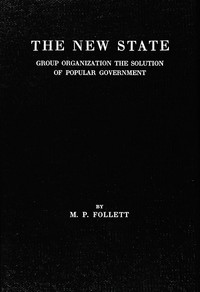
The new state : $b Group organization the solution of popular government
Written by Mary Parker Follett
Chaptra reads alongside you — AI insights, chapter breakdowns and reader discussions for every book. Join free
About this book
Reading guide
Themes, characters and key ideas in The new state : $b Group organization the solution of popular government, written by Chaptra AI.
- about 12 hours
- advanced
- philosophical
- analytical
- visionary
Mary Parker Follett's "The New State" is a seminal early 20th-century political treatise challenging the prevailing models of representative democracy. Follett argues that traditional democratic structures, characterized by party systems and majority rule, are inherently flawed because they fail to foster genuine collective will and individual integration. Instead, she proposes a radical vision of governance rooted in the 'group process,' where individuals actively engage in face-to-face interaction, influencing and integrating differences to create a dynamic, evolving collective. This approach, she contends, is the true path to popular government, enabling authentic individual expression and a more robust, participatory democracy that transcends mechanical forms of organization.
“The essence of democracy is the creation of the group idea.”
Key themes
- The Power of the Group Process and Integration
- This is Follett's central solution, advocating for face-to-face interaction within groups as the crucible for generating true collective will. 'Integration' is presented as the dynamic process of synthesizing differing viewpoints to create novel solutions that satisfy all parties, moving beyond compromise or domination.
- The Failure of Mechanical Democracy
- Follett's foundational theme is a scathing critique of traditional representative democracy, which she labels 'mechanical.' She argues that systems based on party politics, majority rule, and individual voting fail to capture the complexity of human interaction and lead to division, superficial consensus, and suppressed individuality rather than genuine collective will.
- The Individual and the Collective
- Follett challenges the traditional dichotomy between individual freedom and collective authority. She argues that true individuality is not sacrificed but rather enhanced and fully realized through active, integrative participation in the collective. The group provides the context for the individual's growth and expression.
Worth discussing
How does Follett's critique of 'mechanical democracy' resonate with contemporary political challenges, such as polarization or voter apathy?
Chapter-by-chapter breakdowns, character arcs and the full thematic analysis come with a free account.
Discussions
No one has started one yet
Questions this book opens up
No discussions yet
Be the first to start a discussion about this book!
Sign up to start the discussionReviews
No reviews yet
Be the first to review this book!