
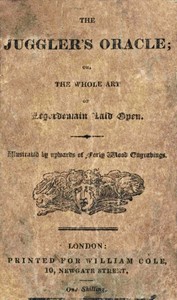
The Juggler's Oracle; or, The Whole Art of Legerdemain Laid Open: Consisting of all the newest and most surprising tricks and experiments with cards, cups and balls, conveyance of money and rings, boxes, fire, strings and knots; with many curious experiments by optical illusion, chymical changes, and magical cards, &c.
Written by H. (Herman) Boaz
Chaptra reads alongside you — AI insights, chapter breakdowns and reader discussions for every book. Join free
About this book
Reading guide
Themes, characters and key ideas in The Juggler's Oracle; or, The Whole Art of Legerdemain Laid Open: Consisting of all the newest and most surprising tricks and experiments with cards, cups and balls, conveyance of money and rings, boxes, fire, strings and knots; with many curious experiments by optical illusion, chymical changes, and magical cards, &c., written by Chaptra AI.
- about 20 hours
- advanced
- instructive
- ingenious
- historical
H. Boaz's "The Juggler's Oracle; or, The Whole Art of Legerdemain Laid Open" is a foundational early 19th-century manual that meticulously details the techniques and principles behind various magic tricks and illusions. It serves as a comprehensive guide for aspiring conjurers, covering everything from card tricks and sleight of hand with coins and rings to more elaborate experiments involving optical illusions and rudimentary chemical changes. The book not only provides step-by-step instructions for numerous deceptions but also emphasizes the crucial elements of performance, audience engagement, and misdirection essential for a successful magician. It stands as a significant historical document, illustrating the state of popular entertainment and the art of illusion during its era.
“The fundamental principle of legerdemain rests upon the quickness of the hand deceiving the eye, aided by judicious misdirection and a confident air.”
Key themes
- Deception and Illusion
- This theme is central to the entire book, as it is a guide to creating illusions. Boaz meticulously details how the human senses and mind can be manipulated through sleight of hand, misdirection, and clever staging. It explores the mechanics of making something appear where it isn't, or vanish where it was, fundamentally playing with the audience's perception of reality. The book implicitly asks what constitutes 'seeing' and how easily it can be fooled.
- Skill, Practice, and Mastery
- Boaz consistently emphasizes that magic is not supernatural but the result of rigorous practice and the development of exceptional manual dexterity and mental discipline. The book is a testament to the idea that complex abilities are acquired through dedicated effort. It instills the value of perseverance and the satisfaction derived from mastering a craft, transforming seemingly impossible feats into achievable skills.
- The Art of Performance and Spectacle
- Beyond mere technique, Boaz highlights the crucial role of performance in making a trick truly magical. This includes the conjurer's demeanor, patter, timing, and ability to control the audience's focus. The book provides insight into the psychology of live entertainment in the early 19th century, where the performer's charisma and stage presence were as vital as their technical skills in creating a memorable spectacle. It teaches that the 'magic' happens not just in the trick itself, but in its presentation.
Worth discussing
How does Boaz's emphasis on misdirection and performance style illuminate the psychology of audience engagement in any form of entertainment?
Chapter-by-chapter breakdowns, character arcs and the full thematic analysis come with a free account.
Discussions
No one has started one yet
Questions this book opens up
No discussions yet
Be the first to start a discussion about this book!
Sign up to start the discussionReviews
No reviews yet
Be the first to review this book!