
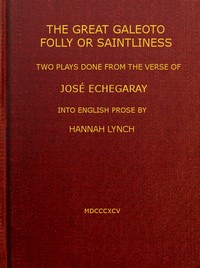
The great Galeoto; Folly or saintliness: two plays done from the verse of José Echegaray into English prose by Hannah Lynch
Written by José Echegaray
Chaptra reads alongside you — AI insights, chapter breakdowns and reader discussions for every book. Join free
About this book
Reading guide
Themes, characters and key ideas in The great Galeoto; Folly or saintliness: two plays done from the verse of José Echegaray into English prose by Hannah Lynch, written by Chaptra AI.
- about 8 hours
- intermediate
- Tragic
- Dramatic
- Intense
José Echegaray's "The Great Galeoto; Folly or Saintliness" explores the destructive power of societal gossip and the tragic consequences it inflicts upon honorable individuals. Centered on Don Julian, his wife Teodora, and their young charge Ernest, the play meticulously unravels how unfounded rumors about their platonic affection escalate into a perceived betrayal, ultimately forcing a tragic reality upon them. It challenges the audience to confront the arbitrary nature of honor and the profound impact of external judgment on personal relationships and identity. The narrative skillfully builds tension, revealing how innocent interactions can be twisted into scandalous narratives by a prejudiced society, leading to a devastating climax.
“Society, society, society! Always society! Oh, the great Galeoto!”
Key themes
- The Destructive Power of Gossip and Societal Judgment
- This is the central theme of the play. Echegaray illustrates how unfounded rumors and collective societal judgment can create a false reality that ultimately destroys innocent lives and relationships. The 'Galeoto' is society itself, acting as the go-between that pushes characters into the very situations it condemns.
- Honor and Reputation
- The play deeply explores the concept of honor, particularly male honor (Don Julian's and Ernest's) and female reputation (Teodora's). Characters are driven to extreme actions, including violence and self-sacrifice, to defend their honor against the stain of perceived scandal, highlighting its fragile and often arbitrary nature.
- Love, Loyalty, and Sacrifice
- The play examines different forms of love – Don Julian's paternal affection for Ernest and conjugal love for Teodora, Teodora's innocent affection for both men, and Ernest's gratitude and respect. These bonds are tested and ultimately distorted by external pressures, leading to profound sacrifices and tragic outcomes for all involved.
Worth discussing
How does Echegaray define 'Galeoto' in the context of the play, and what is its significance?
Chapter-by-chapter breakdowns, character arcs and the full thematic analysis come with a free account.
Discussions
No one has started one yet
Questions this book opens up
No discussions yet
Be the first to start a discussion about this book!
Sign up to start the discussionReviews
No reviews yet
Be the first to review this book!