
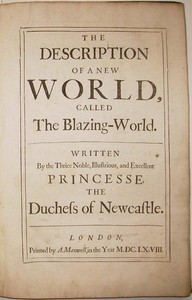
The Description of a New World, Called the Blazing-World
Written by Margaret Cavendish Newcastle
Chaptra reads alongside you — AI insights, chapter breakdowns and reader discussions for every book. Join free
About this book
Reading guide
Themes, characters and key ideas in The Description of a New World, Called the Blazing-World, written by Chaptra AI.
- about 8 hours
- advanced
- imaginative
- philosophical
- utopian
Margaret Cavendish's "The Blazing-World" is a groundbreaking 17th-century work of speculative fiction, presenting a unique blend of fantasy, philosophy, and proto-science fiction. It chronicles the journey of a young lady, abducted by a merchant, who survives a shipwreck and finds herself in a parallel, fantastical universe inhabited by anthropomorphic creatures. Through her intelligence and virtue, she rises to become the Empress of this Blazing-World, establishing a utopian society based on reason and order. The narrative further evolves into a meta-fictional exploration as the author, Cavendish herself, enters the story as the Empress's 'scribe' and 'spiritual friend,' debating philosophical concepts and asserting the power of imagination and intellect.
“"For she cared not for the natural power of the Emperor, but for the supernatural power of the Spirits."”
Key themes
- Feminist Agency and Power
- This is a central theme, exploring the capacity of women to achieve intellectual and political power. The Empress's journey from abducted victim to sovereign ruler, her intellectual dominance over male philosophers, and her ability to create and govern an entire world, directly challenge 17th-century patriarchal norms. Cavendish uses the Blazing-World to imagine a space where a woman's intellect and leadership are not only accepted but celebrated as superior.
- Scientific Inquiry and Knowledge
- Cavendish uses the Blazing-World to critique and explore different modes of scientific inquiry prevalent in her era. Through the various animal-headed scientists (bear-men as experimental philosophers, bird-men as astronomers, worm-men as natural philosophers), she examines the strengths and weaknesses of empiricism, rationalism, and observation. The Empress often finds their methods limited and seeks a more holistic or spiritual understanding, reflecting Cavendish's own skepticism towards the Royal Society's materialist approach.
- Imagination and Authorial Control
- Cavendish explicitly explores the power of imagination, both as a creative force and as a means of understanding the world. The entire Blazing-World is a product of imagination, and the author's insertion of herself into the narrative underscores the writer's ultimate control over their fictional universe. This theme delves into meta-fiction, examining the relationship between author, text, and reader, and asserting the legitimacy of imaginative creation as a form of knowledge.
Worth discussing
How does Cavendish use the Blazing-World as a vehicle for philosophical and scientific discourse? What specific ideas does she explore?
Chapter-by-chapter breakdowns, character arcs and the full thematic analysis come with a free account.
Discussions
No one has started one yet
Questions this book opens up
No discussions yet
Be the first to start a discussion about this book!
Sign up to start the discussionReviews
No reviews yet
Be the first to review this book!