
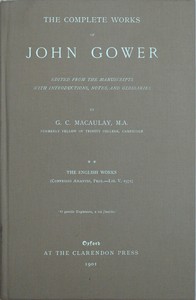
The complete works of John Gower, volume 2 : $b The English works
Written by John Gower
Chaptra reads alongside you — AI insights, chapter breakdowns and reader discussions for every book. Join free
About this book
Reading guide
Themes, characters and key ideas in The complete works of John Gower, volume 2 : $b The English works, written by Chaptra AI.
- about 8 hours
- advanced
- didactic
- philosophical
- moralistic
John Gower's "The Complete Works, Volume 2: The English Works" primarily presents "Confessio Amantis," a monumental late 14th-century poetic narrative. This work unfolds as a confessional dialogue between a lovelorn narrator, Amans, and the priest of Venus, Genius, who imparts moral lessons through a vast array of illustrative tales. Gower meticulously explores the complexities of love, morality, and societal corruption, using the framework of the seven deadly sins to critique temporal rulers, the clergy, and human behavior. The volume begins with a detailed prologue where Gower articulates his intention to blend wisdom with pleasure, reflecting on the challenges of moral storytelling amidst widespread societal discord. "Confessio Amantis" stands as a significant contribution to early English literature, showcasing Gower's didactic purpose and narrative skill, often drawing comparisons to his contemporary, Geoffrey Chaucer.
“Forthi good is that we also / With newe thinges bothe two / Miht make us merie, and to the lore / Of hem that writen us tofore / In sondri wise our tale telle.”
Key themes
- Love (Courtly, Moral, and Spiritual)
- Love is the overarching theme, explored in its myriad forms. Gower dissects courtly love conventions, examining its pitfalls and virtues. He moves beyond romantic love to consider love's moral dimensions, particularly how it intersects with the seven deadly sins, and ultimately elevates it to a spiritual, philosophical plane, advocating for a love aligned with reason and divine order.
- Morality and Vice
- The poem is fundamentally a moral treatise, structured around the seven deadly sins. Gower meticulously examines each sin (Pride, Envy, Wrath, Sloth, Avarice, Gluttony, Lechery) through Amans's confession and Genius's illustrative tales, demonstrating how these vices corrupt individuals and society. The work advocates for virtuous conduct as essential for personal well-being and societal harmony.
- Wisdom and Didacticism
- Gower explicitly states his intention to blend wisdom ('lore') with pleasure ('merie') in his writing. The entire poem serves as a didactic vehicle, aiming to instruct its audience on moral principles, human nature, and the path to a virtuous life. Genius, as the principal narrator, is the embodiment of this didactic purpose, imparting knowledge through stories.
Worth discussing
How does Gower's approach to moral instruction in 'Confessio Amantis' compare to other didactic works of the medieval period?
Chapter-by-chapter breakdowns, character arcs and the full thematic analysis come with a free account.
Discussions
No one has started one yet
Questions this book opens up
No discussions yet
Be the first to start a discussion about this book!
Sign up to start the discussionReviews
No reviews yet
Be the first to review this book!