
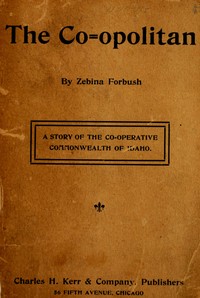
The Co-opolitan: A Story of the Co-operative Commonwealth of Idaho
Written by Zebina Forbush
Chaptra reads alongside you — AI insights, chapter breakdowns and reader discussions for every book. Join free
About this book
Reading guide
Themes, characters and key ideas in The Co-opolitan: A Story of the Co-operative Commonwealth of Idaho, written by Chaptra AI.
- about 8 hours
- intermediate
- Idealistic
- Hopeful
- Social commentary
The Co-opolitan: A Story of the Co-operative Commonwealth of Idaho by Zebina Forbush is a late 19th-century novel set against the backdrop of severe economic disparity in 1897 America. The narrative follows Mr. Braden, a young man grappling with personal losses, who encounters the charismatic John Thompson and is introduced to the transformative ideals of co-operation. Inspired by Thompson's vision for social and economic equality, Braden joins the ambitious project to establish 'Co-opolis' in Idaho. The book sets the stage for an exploration of community building, utopian idealism, and the pursuit of a new social order, reflecting the era's fervent debates on wealth distribution and alternative societal structures.
“In an America rich beyond measure, it was a bitter irony that so many starved for want of a just share.”
Key themes
- Co-operation vs. Individualism
- This is the central ideological conflict of the novel, exploring the merits of collective effort, shared resources, and mutual responsibility as opposed to the prevailing individualistic, competitive ethos of late 19th-century capitalism. The book champions co-operation as the path to social harmony and economic equity.
- Economic Inequality and Social Justice
- The novel directly addresses the stark wealth disparity of the Gilded Age, where immense national wealth coexisted with widespread poverty. It functions as a critique of the prevailing economic system and advocates for a more just distribution of resources and opportunities.
- Utopianism and Idealism
- The book is a prime example of utopian literature, exploring the possibility and challenges of creating an ideal society based on specific principles. It delves into the power of human idealism to envision and attempt to construct a better world, often against overwhelming odds.
Worth discussing
How does Forbush portray the economic disparities of 1897 America, and how do these descriptions resonate with contemporary issues?
Chapter-by-chapter breakdowns, character arcs and the full thematic analysis come with a free account.
Discussions
No one has started one yet
Questions this book opens up
No discussions yet
Be the first to start a discussion about this book!
Sign up to start the discussionReviews
No reviews yet
Be the first to review this book!