
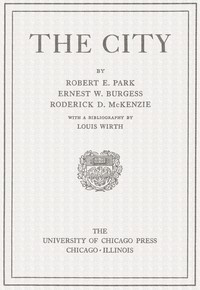
The city
Written by E. W. (Ernest Watson) Burgess,Robert Ezra Park,Roderick Duncan McKenzie
Chaptra reads alongside you — AI insights, chapter breakdowns and reader discussions for every book. Join free
About this book
Reading guide
Themes, characters and key ideas in The city, written by Chaptra AI.
- about 12 hours
- advanced
- analytical
- academic
- sociological
"The City" by Robert E. Park, Ernest W. Burgess, and Roderick D. McKenzie is a seminal work in urban sociology, presenting a foundational framework for understanding the complexities of urban environments. Published in the mid-20th century, this collection of essays posits the city as a dynamic social organism, a 'state of mind,' and a crucible for human behavior, rather than merely a physical space. The authors explore how urban growth, social organization, and ecological processes shape individual and collective life, introducing concepts like urban ecology, social disorganization, and community dynamics. It provides a multidisciplinary lens—ecological, economic, and ethical—to analyze the intricate interplay of forces that define city living, profoundly influencing subsequent urban studies and sociological thought.
“The city is not merely a congeries of individual men and of social conveniences -- streets, buildings, electric lights, tramways, and telephones -- but a product of nature, and particularly of human nature.”
Key themes
- Urban Ecology
- This theme explores the city as a living organism or ecosystem, where different populations and activities compete for space and resources, leading to distinct 'natural areas' and processes like invasion, succession, and dominance. It provides a framework for understanding the spatial organization and growth of urban areas.
- The City as a State of Mind & Moral Order
- This theme emphasizes that the city is more than just a physical space; it's a cultural, psychological, and moral entity. It shapes customs, traditions, attitudes, and sentiments, profoundly influencing the consciousness and behavior of its inhabitants. It explores how urban life transforms individual identity and collective morality.
- Social Disorganization & Community
- The book explores how the rapid growth and diverse nature of cities can lead to social disorganization, characterized by the breakdown of traditional social controls, family structures, and community bonds. Simultaneously, it examines how new forms of community and social organization emerge in response to urban conditions, adapting to anonymity and diversity.
Worth discussing
How does "The City" define the urban environment beyond its physical characteristics, and how relevant is this definition today?
Chapter-by-chapter breakdowns, character arcs and the full thematic analysis come with a free account.
Discussions
No one has started one yet
Questions this book opens up
No discussions yet
Be the first to start a discussion about this book!
Sign up to start the discussionReviews
No reviews yet
Be the first to review this book!