
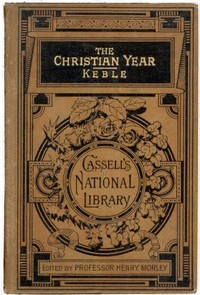
The Christian Year
Written by John Keble
Chaptra reads alongside you — AI insights, chapter breakdowns and reader discussions for every book. Join free
About this book
Reading guide
Themes, characters and key ideas in The Christian Year, written by Chaptra AI.
- about 15 hours
- advanced
- uplifting
- reflective
- devotional
John Keble's "The Christian Year" is a seminal collection of devotional poetry published in the early 19th century, meticulously structured around the Anglican liturgical calendar. Each poem corresponds to a specific Sunday or holy day, offering reflections designed to deepen the reader's spiritual life and understanding of Christian faith. Keble, a key figure in the Oxford Movement, aimed to articulate the inherent beauty and profound significance of Christian worship and the cyclical nature of religious life. The work serves as a spiritual guide, encouraging contemplative engagement with sacred time and the divine presence within both church tradition and the natural world, fostering a sense of reverence and devotion.
“The trivial round, the common task, / Would furnish all we ought to ask.”
Key themes
- The Liturgical Cycle and Sacred Time
- This theme is the structural and conceptual backbone of the entire collection. Keble meticulously follows the Christian liturgical calendar, demonstrating how the Church's annual cycle of feasts and fasts provides a profound framework for understanding Christian doctrine, spiritual growth, and the rhythm of divine grace. Each poem is a meditation on the specific theological significance of a particular day, guiding the reader through the narrative of salvation history and the ongoing life of faith.
- Nature as a Revelation of God
- Keble frequently employs natural imagery to illustrate spiritual truths and demonstrate God's omnipresence. The changing seasons, the beauty of flowers, the light of dawn, and the vastness of the natural world are consistently presented as mirrors reflecting divine attributes, order, and grace. Nature is not just a backdrop but an active participant in spiritual understanding, a 'book of God' from which lessons of humility, providence, and beauty can be learned.
- The Sacramental Principle and the Sacred in the Mundane
- A cornerstone of Keble's theology, this theme emphasizes that divine grace and presence are not confined to grand miracles or explicit religious rituals, but permeate everyday life and the physical world. The poems encourage readers to perceive the sacred within the seemingly 'trivial round' and 'common task,' transforming ordinary experiences into opportunities for spiritual contemplation and communion with God. This extends to the understanding of sacraments as outward signs of inward grace, making the invisible visible through earthly forms.
Worth discussing
How does Keble use the liturgical calendar to structure a spiritual journey for the reader?
Chapter-by-chapter breakdowns, character arcs and the full thematic analysis come with a free account.
Discussions
No one has started one yet
Questions this book opens up
No discussions yet
Be the first to start a discussion about this book!
Sign up to start the discussionReviews
No reviews yet
Be the first to review this book!