
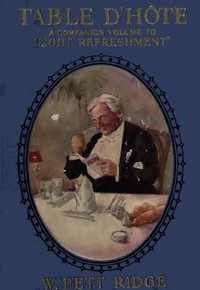
Table d'Hôte
Written by W. Pett (William Pett) Ridge
Chaptra reads alongside you — AI insights, chapter breakdowns and reader discussions for every book. Join free
About this book
Reading guide
Themes, characters and key ideas in Table d'Hôte, written by Chaptra AI.
- about 8 hours
- intermediate
- humorous
- witty
- lighthearted
W. Pett Ridge's "Table d'Hôte" is a collection of early 20th-century humorous short stories that offer a satirical glimpse into British social life. Through engaging characters and absurd situations, the book provides a lighthearted critique of societal norms, family dynamics, and human eccentricities. The opening story, featuring Mr. and Mrs. Baynes, immediately sets the tone with a comical domestic dispute over a system of fines and a surprise inheritance. This initial exchange exemplifies the author's talent for witty banter and subtle exploration of marital power dynamics, hinting at deeper emotional layers beneath the comedic surface.
“"My dear, a system of fines encourages efficiency and discourages… well, discourages certain domestic extravagances."”
Key themes
- Marital Dynamics and Power
- This theme explores the intricate power struggles, communication styles, and evolving roles within marriage. Ridge uses the domestic setting of Mr. and Mrs. Baynes to highlight how financial independence, personal assertiveness, and perceived authority play out in everyday relationships, often with humorous and unexpected results.
- British Social Satire and Propriety
- Ridge's collection satirizes various aspects of early 20th-century British social life, including its rigid class structures, adherence to propriety, and the often-absurd attempts to maintain decorum. The humor stems from the characters' earnest efforts to uphold social norms, even when these norms lead to comical or illogical situations.
- The Absurdity of Human Behavior
- This theme explores the inherent quirks and illogical tendencies in human actions and decisions. Ridge delights in showcasing how individuals often create elaborate systems or hold onto peculiar beliefs that, when viewed objectively, are utterly comical, providing a lighthearted critique of human nature.
Worth discussing
How does W. Pett Ridge use humor to critique social norms and expectations in early 20th-century Britain?
Chapter-by-chapter breakdowns, character arcs and the full thematic analysis come with a free account.
Discussions
No one has started one yet
Questions this book opens up
No discussions yet
Be the first to start a discussion about this book!
Sign up to start the discussionReviews
No reviews yet
Be the first to review this book!