
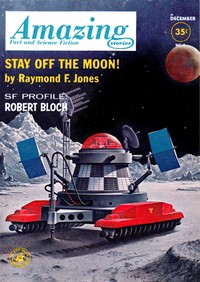
Stay off the Moon!
Written by Raymond F. Jones
Chaptra reads alongside you — AI insights, chapter breakdowns and reader discussions for every book. Join free
About this book
Reading guide
Themes, characters and key ideas in Stay off the Moon!, written by Chaptra AI.
- about 8 hours
- intermediate
- mysterious
- tense
- cautionary
Raymond F. Jones's "Stay off the Moon!" is a chilling 1960s science fiction novel that explores the perilous implications of lunar exploration. The narrative follows Jim Cochran, a scientist operating a robotic lunar laboratory, who uncovers unsettling evidence suggesting the Moon's extra-galactic origin and the presence of organic compounds, hinting at past life. As his investigations deepen, Cochran becomes convinced of a sinister, potentially sentient threat concealed within the Moon's core, one that poses an existential danger to humanity. Despite his desperate warnings, authorities dismiss his findings, leading to a tragic climax where a subsequent manned mission faces dire, unforeseen consequences. The book serves as a cautionary tale, delving into themes of scientific hubris, the unknown terrors of space, and the ethical responsibilities of discovery.
“The Moon is not merely barren rock; it is a tomb, or perhaps, a warning.”
Key themes
- The Dangers of Unchecked Ambition / Hubris
- The novel explores the perilous consequences of humanity's relentless drive to explore and exploit new frontiers without fully understanding the potential repercussions. The desire to 'conquer' the Moon leads directly to disturbing an ancient, dangerous presence, suggesting that some mysteries are better left undisturbed.
- Fear of the Unknown / Cosmic Horror
- A core theme is the profound terror inspired by encounters with truly alien and incomprehensible entities. The Moon's extra-galactic origin and the 'sinister' presence within it tap into humanity's deepest anxieties about its place in a vast, potentially hostile universe.
- Scientific Ethics and Responsibility
- The novel implicitly raises questions about the ethical obligations of scientists when their discoveries pose existential threats. Cochran's struggle to be heard highlights the responsibility to not only discover but also to effectively communicate dangers, and the societal responsibility to heed such warnings.
Worth discussing
How does the novel challenge humanity's perception of the Moon as a benign celestial body?
Chapter-by-chapter breakdowns, character arcs and the full thematic analysis come with a free account.
Discussions
No one has started one yet
Questions this book opens up
No discussions yet
Be the first to start a discussion about this book!
Sign up to start the discussionReviews
No reviews yet
Be the first to review this book!