
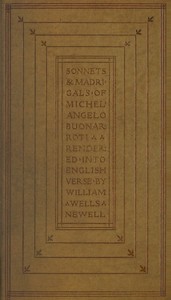
Sonnets and madrigals of Michelangelo Buonarroti
Written by Michelangelo Buonarroti
Chaptra reads alongside you — AI insights, chapter breakdowns and reader discussions for every book. Join free
About this book
Reading guide
Themes, characters and key ideas in Sonnets and madrigals of Michelangelo Buonarroti, written by Chaptra AI.
- about 8 hours
- advanced
- contemplative
- passionate
- spiritual
Michelangelo Buonarroti's "Sonnets and Madrigals" is a profound collection of Renaissance poetry, offering an intimate window into the mind of the celebrated artist. Far from a mere side pursuit, these verses reveal Michelangelo's deep philosophical and spiritual reflections on love, beauty, and artistry, often mirroring the meticulous craft of his sculptural and painted works. The collection chronicles an emotional and intellectual journey, grappling with earthly affections and aspirations for divine transcendence. It underscores his reluctance to embrace the title of poet, despite the intense emotional investment and formal mastery evident in his lyrical expressions, ultimately solidifying his legacy as a multifaceted genius whose poetry was initially overlooked but later recognized for its rich depth.
“Non ha l'ottimo artista alcun concetto / Ch'un marmo solo in sé non circonscriva / Col suo soverchio, e solo a quello arriva / La man che ubbidisce all'intelletto.”
Key themes
- Love (Platonic and Spiritual)
- Michelangelo's poetry is deeply permeated by various forms of love, predominantly filtered through a Neoplatonic lens. Earthly affection, whether for a friend, a patron, or an idealized figure, is consistently presented as a stepping stone to divine love. The poems explore the transformative power of love, its capacity to inspire artistic creation, and its role in the soul's ascent towards God. This theme often grapples with the tension between sensual attraction and spiritual devotion, seeking to sublimate the former into the latter.
- Spirituality and Faith
- Michelangelo's deep Catholic faith and personal piety are central to the collection. The poems frequently express fervent devotion, spiritual yearning, and a profound awareness of sin, repentance, and the need for divine grace. They reflect a soul grappling with theological concepts, seeking salvation, and aspiring to a closer union with God. This theme often intertwines with Neoplatonism, as the ascent to divine love is seen as a spiritual journey towards redemption.
- Beauty (Divine and Artistic)
- For Michelangelo, beauty is not merely aesthetic but a profound philosophical and spiritual concept. It is seen as an emanation of God, a divine spark present in both nature and human creations. The poems explore the power of beauty to inspire, elevate, and even condemn the soul. Artistic beauty, particularly in sculpture, is presented as a process of revealing the divine form hidden within the material, mirroring the soul's journey towards purification and recognition of ultimate truth.
Worth discussing
How does Michelangelo's poetry reflect his work as a sculptor and painter? What parallels can be drawn between his artistic and poetic processes?
Chapter-by-chapter breakdowns, character arcs and the full thematic analysis come with a free account.
Discussions
No one has started one yet
Questions this book opens up
No discussions yet
Be the first to start a discussion about this book!
Sign up to start the discussionReviews
No reviews yet
Be the first to review this book!