Chaptra
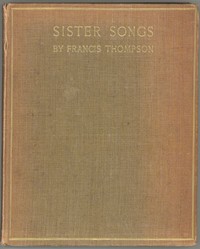
Cover of Sister Songs: An Offering to Two Sisters

Sister Songs: An Offering to Two Sisters

Written by Francis Thompson

Not rated yet — tap a star to review it

Chaptra reads alongside you — AI insights, chapter breakdowns and reader discussions for every book. Join free

About this book

"Sister Songs: An Offering to Two Sisters" by Francis Thompson is a poetic collection written during the late 19th century, likely around the Victorian era. This book is a unique offering that celebrates the bond of sisterhood and the beauty of nature, exploring themes of love, innocence, and the transcendent qualities of spring. The poem unfolds in various parts, each adorned with vivid imagery and rich metaphors symbolizing the connection between the speaker and the two sisters, Monica and Madeline Meynell, to whom the work is dedicated. Through the personification of nature, particularly in the guise of the goddess Spring, Thompson expresses admiration, longing, and a deep emotional resonance with the purity and innocence of childhood. The verses blend romantic idealism with a gentle nostalgia, culminating in a heartfelt tribute to the sisters that intertwines their existence with the cycle of nature, enchanting readers with its lyrical beauty while capturing the essence of familial love and companionship.

Read it with a club

Chaptra's poetry and plays clubs — small groups reading the same books and talking as they go.

All clubs
An open book and a notebook on a desk in front of a bookcase

Shakespeare Out Loud

Poetry and plays

  • 4 members
  • 4 discussions
  • Active 20h ago

Plays are scripts, not novels. We read them aloud, in parts, and it changes everything. This is a Chaptra house club — set up and moderated by us to get the conversation going. Open to everyone; jump in anywhere.

Read Sister Songs: An Offering to Two Sisters alongside people who are reading it too.

Chaptra Prime — paid clubs, every club feature, and unlimited reading support, for $5 a month or $60 once.

See Prime

Reading guide

Themes, characters and key ideas in Sister Songs: An Offering to Two Sisters, written by Chaptra AI.

  • about 8 hours
  • advanced
  • uplifting
  • romantic
  • lyrical

Francis Thompson's "Sister Songs: An Offering to Two Sisters" is a deeply lyrical and spiritually infused poetic collection from the late Victorian era, dedicated to Monica and Madeline Meynell. The work is a profound celebration of sisterhood, childhood innocence, and the transformative beauty of nature, particularly personified as the goddess Spring. Through rich imagery and complex metaphors, Thompson intertwines the purity of the two girls with the cyclical renewal of the natural world, suggesting a divine presence in their youthful spirit. It serves as a heartfelt tribute, exploring themes of transcendent love, beauty, and the delicate, fleeting nature of innocence, all rendered with a distinctive blend of romantic idealism and spiritual contemplation.

She has the bird's heart in her, and the bird's song.

Key themes

Innocence and Childhood
Central to the poem, this theme explores the purity, untainted spirit, and inherent goodness of childhood as embodied by the Meynell sisters. Thompson views this innocence as a sacred state, reflecting a proximity to the divine and a fragile beauty that is both celebrated and, at times, mourned for its transience.
Nature and Spirituality
Thompson seamlessly intertwines the natural world with spiritual transcendence. Nature, especially in the form of Spring, is not just a backdrop but an active participant and a manifestation of divine presence. The beauty and cycles of nature are seen as reflections of God's handiwork, and the sisters' connection to nature further elevates their spiritual significance.
Love and Admiration
The poem is fundamentally an 'offering' born of profound love and admiration. The speaker's affection for the Meynell sisters is not merely familial but verges on a spiritual devotion, seeing them as sources of inspiration and beauty. This love is expressed through lavish praise, protective sentiment, and a deep emotional resonance.

Worth discussing

How does Thompson use the personification of Spring to deepen our understanding of the sisters' innocence and spiritual significance?

Chapter-by-chapter breakdowns, character arcs and the full thematic analysis come with a free account.

Discussions

No one has started one yet

Join

Questions this book opens up

No discussions yet

Be the first to start a discussion about this book!

Sign up to start the discussion

Reviews

No reviews yet

Be the first to review this book!