
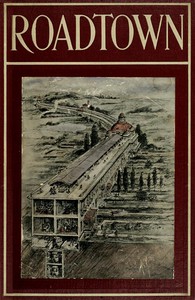
Roadtown
Written by Edgar Chambless
Chaptra reads alongside you — AI insights, chapter breakdowns and reader discussions for every book. Join free
About this book
Read it with a club
Chaptra's science fiction and fantasy clubs — small groups reading the same books and talking as they go.


Sci-Fi That Got It Right (And Wrong)
Science fiction and fantasy
- 4 members
- 4 discussions
- Active Sep 11
Old science fiction, read against what actually happened. We keep score. This is a Chaptra house club — set up and moderated by us to get the conversation going. Open to everyone; jump in anywhere.
Read Roadtown alongside people who are reading it too.
Also here: The Dragon Problem, Hard SF vs Soft SF
Chaptra Prime — paid clubs, every club feature, and unlimited reading support, for $5 a month or $60 once.
See PrimeReading guide
Themes, characters and key ideas in Roadtown, written by Chaptra AI.
- about 8 hours
- intermediate
- visionary
- analytical
- hopeful
Edgar Chambless's "Roadtown" is an early 20th-century speculative work envisioning a radical solution to urban inefficiencies. Following a financial crisis, the author-protagonist conceptualizes a linear city where housing and transportation are seamlessly integrated. This utopian vision aims to optimize daily life through features like mechanized housekeeping, cooperative agriculture, and streamlined distribution, fostering a society free from the burdens of traditional city living. The book meticulously explores how this revolutionary urban design could address the challenges of modern civilization, presenting a blueprint for a more efficient and harmonious existence.
“Our cities are monuments to inefficiency, sprawling beasts that consume time and spirit.”
Key themes
- Utopianism and Social Engineering
- The core theme, exploring the possibility of creating a perfect society through rational design and systematic organization. Chambless presents Roadtown as an ideal model for human living, meticulously planned to eliminate societal ills and maximize well-being through communal services and integrated infrastructure.
- Efficiency and Modernization
- A driving force behind Roadtown's design, this theme centers on the belief that societal problems can be solved by eliminating waste and optimizing processes. Chambless advocates for a highly efficient system in all aspects of life, from transportation to domestic tasks, to free individuals for higher pursuits.
- Critique of Industrial Urbanism
- Chambless's work serves as a direct response to and critique of the chaotic, inefficient, and often dehumanizing conditions of early 20th-century industrial cities. He highlights issues like pollution, congestion, social fragmentation, and the burdens of daily life as inherent flaws in traditional urban development.
Worth discussing
To what extent do Roadtown's critiques of traditional urban living remain relevant today?
Chapter-by-chapter breakdowns, character arcs and the full thematic analysis come with a free account.
Discussions
No one has started one yet
Questions this book opens up
No discussions yet
Be the first to start a discussion about this book!
Sign up to start the discussionReviews
No reviews yet
Be the first to review this book!