
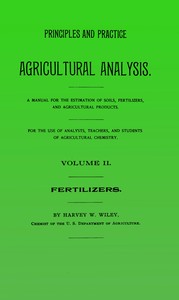
Principles and practice of agricultural analysis. Volume 2 (of 3), Fertilizers
Written by Harvey Washington Wiley
Chaptra reads alongside you — AI insights, chapter breakdowns and reader discussions for every book. Join free
About this book
Read it with a club
Small groups reading the same books and talking as they go.


News
- 4 members
- 1,813 discussions
- Active Sep 11
Read Principles and practice of agricultural analysis. Volume 2 (of 3), Fertilizers alongside people who are reading it too.
Also here: News Bulletin, Just Joking....
Chaptra Prime — paid clubs, every club feature, and unlimited reading support, for $5 a month or $60 once.
See PrimeReading guide
Themes, characters and key ideas in Principles and practice of agricultural analysis. Volume 2 (of 3), Fertilizers, written by Chaptra AI.
- about 15 hours
- advanced
- instructive
- rigorous
- systematic
Harvey W. Wiley's "Principles and Practice of Agricultural Analysis. Volume 2 (of 3), Fertilizers" is a foundational scientific manual from the late 19th century, meticulously detailing the chemical analysis of various fertilizing materials. Building upon the previous volume on soils, this book serves as an indispensable guide for agricultural chemists, students, and educators, outlining precise methods and standards for evaluating both natural and manufactured fertilizers. It aims to provide in-depth knowledge of their chemical composition and agricultural value, emphasizing the practical application of scientific principles to enhance crop productivity. The work reflects a commitment to rigorous methodology and standardization in the burgeoning field of agricultural chemistry, solidifying its place as a cornerstone text for its era.
“The proper estimation of fertilizers is second only in importance to that of the soil itself.”
Key themes
- Scientific Methodology and Standardization
- This is the core theme, emphasizing the critical importance of precise, repeatable, and universally accepted methods for chemical analysis. The book is essentially a compendium of such methods, advocating for their consistent application to ensure reliable results and comparability across different laboratories and regions. This theme underpins the entire work, arguing that only through rigorous methodology can accurate assessments of fertilizer value be made.
- Agricultural Productivity and Resource Optimization
- The ultimate practical goal of the book's scientific content is to enhance agricultural output and ensure the efficient use of resources. By accurately analyzing fertilizers, farmers and agricultural scientists could understand which nutrients were deficient in soils, which fertilizers would be most effective, and how to avoid wasteful application of ineffective or overpriced materials. This directly contributed to maximizing crop yields and optimizing the economic return on agricultural investments.
- Chemical Composition and Value Assessment
- This theme explores the direct link between the chemical makeup of a fertilizer and its practical, economic, and agricultural worth. The book systematically teaches how to identify and quantify key beneficial elements (e.g., N, P, K) and, by extension, how to determine if a fertilizer product lives up to its claims. This was crucial in an era where fraudulent or ineffective products could easily deceive farmers, making accurate chemical analysis a tool for consumer protection and informed decision-making.
Worth discussing
How did the analytical methods described in Wiley's volume influence agricultural practices and economic decisions in the late 19th and early 20th centuries?
Chapter-by-chapter breakdowns, character arcs and the full thematic analysis come with a free account.
Discussions
No one has started one yet
Questions this book opens up
No discussions yet
Be the first to start a discussion about this book!
Sign up to start the discussionReviews
No reviews yet
Be the first to review this book!