
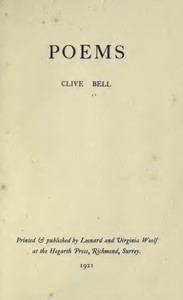
Poems
Written by Clive Bell
Chaptra reads alongside you — AI insights, chapter breakdowns and reader discussions for every book. Join free
About this book
Reading guide
Themes, characters and key ideas in Poems, written by Chaptra AI.
- about 6 hours
- intermediate
- contemplative
- lyrical
- introspective
Clive Bell's "Poems," published in 1921 by Hogarth Press, is a significant collection reflecting the early 20th-century modernist movement through its lyrical exploration of nature, introspection, and the interplay between art and life. The work showcases Bell's versatility, moving from contemplative meditations on the natural world and human emotion to lighthearted and witty verses celebrating friendship. As an automatically generated summary suggests, the collection invites readers into a vivid world where personal experience, beauty, and the ephemeral quality of existence are captured with both sincerity and intellectual playfulness. Through its diverse range, exemplified by poems like "To Gerald Shove" and "The Last Infirmity," Bell establishes a noteworthy contribution to modernist poetry, engaging with themes of time, emotion, and the search for meaning.
“"The fleeting beauty of the dawn, a whisper in the soul, where transient hues are born."”
Key themes
- Nature and Contemplation
- Bell frequently uses the natural world as a backdrop for introspection and philosophical musing. Nature is not merely descriptive but serves as a catalyst for deeper thought about existence, beauty, and the human condition. The serene observation of landscapes often leads to profound personal reflections.
- Human Emotion and Introspection
- The collection deeply explores the complexities of human feelings, including love, friendship, melancholy, and joy. Bell's introspection is a cornerstone of his poetry, delving into the subjective experience of emotions and their impact on perception and understanding. He captures the nuances of the inner life with sensitivity and honesty.
- Art, Beauty, and Existence
- Given Bell's background as a prominent art critic, it is natural that his poetry explores the nature of beauty, its perception, and its role in human existence. This theme examines how art (including poetry itself) attempts to capture or interpret life's fleeting beauty and the philosophical implications of aesthetic experience. It questions what makes something beautiful and how that beauty informs our understanding of the world and ourselves.
Worth discussing
How does Bell's background as an art critic influence the aesthetic and thematic concerns in his poetry?
Chapter-by-chapter breakdowns, character arcs and the full thematic analysis come with a free account.
Discussions
No one has started one yet
Questions this book opens up
No discussions yet
Be the first to start a discussion about this book!
Sign up to start the discussionReviews
No reviews yet
Be the first to review this book!