
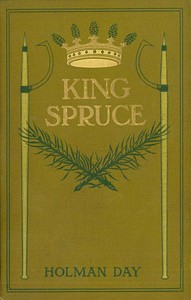
King Spruce, A Novel
Written by Holman Day
Chaptra reads alongside you — AI insights, chapter breakdowns and reader discussions for every book. Join free
About this book
Read it with a club
Chaptra's love and romance clubs — small groups reading the same books and talking as they go.


Enemies to Lovers Tribunal
Love and romance
- 4 members
- 4 discussions
- Active Sep 11
One trope, examined to destruction. We rank them, we argue, and we throw out the ones that are really just "he was rude once at a party". This is a Chaptra house club — set up and moderated by us to get the conversation going. Open to everyone; jump in anywhere.
Read King Spruce, A Novel alongside people who are reading it too.
Also here: Hopeless Romantics Anonymous
Chaptra Prime — paid clubs, every club feature, and unlimited reading support, for $5 a month or $60 once.
See PrimeReading guide
Themes, characters and key ideas in King Spruce, A Novel, written by Chaptra AI.
- about 8 hours
- intermediate
- Gritty
- Ambitious
- Conflict-driven
Holman Day's "King Spruce" is an early 20th-century novel set against the backdrop of the powerful timber industry, chronicling the journey of Dwight Wade, an idealistic young man. Wade arrives at the heart of the logging world, challenging the established order dominated by figures like the autocratic "King Spruce," John Barrett, and the Honorable Pulaski D. Britt. The narrative explores themes of class struggle, integrity, and ambition as Wade grapples with the ruthless complexities of the lumber business, advocating for sustainable practices. His aspirations are further complicated by a burgeoning romantic entanglement with Barrett's daughter, Elva, intertwining personal desires with societal conflict. The novel thus presents a compelling drama of individual conscience against corporate power and tradition.
“"The woods answer to no king but the man who understands their heart, not just their timber."”
Key themes
- Class Struggle and Social Justice
- The novel vividly portrays the stark contrast between the powerful lumber barons and the struggling stumpage buyers and townspeople. It highlights the systemic inequalities and the exploitation inherent in a system where a few powerful individuals control the livelihoods of many, leading to widespread frustration and a yearning for fairness.
- Man vs. Nature / Environmentalism
- The conflict between exploitative logging practices and sustainable forestry is a major thematic pillar. Dwight Wade's advocacy for involving young men in sustainable practices directly challenges the dominant mindset of resource extraction. The novel, set in the early 20th century, can be seen as an early exploration of environmental consciousness and the long-term impact of human industry on natural landscapes.
- Integrity vs. Corruption
- Central to the narrative is Dwight Wade's unwavering commitment to ethical practices and his refusal to compromise his ideals in the face of widespread corruption and the immense pressure exerted by powerful figures like John Barrett. The novel explores the personal cost and moral fortitude required to uphold integrity when it conflicts with ambition and survival.
Worth discussing
How does Holman Day use the setting of the timber industry to symbolize broader societal conflicts of the early 20th century?
Chapter-by-chapter breakdowns, character arcs and the full thematic analysis come with a free account.
Discussions
No one has started one yet
Questions this book opens up
No discussions yet
Be the first to start a discussion about this book!
Sign up to start the discussionReviews
No reviews yet
Be the first to review this book!