
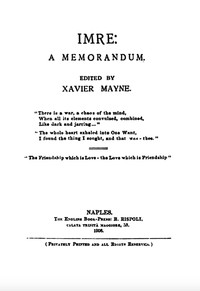
Imre: A Memorandum
Written by Edward Prime-Stevenson
Chaptra reads alongside you — AI insights, chapter breakdowns and reader discussions for every book. Join free
About this book
Reading guide
Themes, characters and key ideas in Imre: A Memorandum, written by Chaptra AI.
- about 6 hours
- intermediate
- introspective
- poignant
- earnest
Edward Prime-Stevenson's "Imre: A Memorandum" is a pioneering work of early gay literature, published in 1906, that chronicles the emotional and intellectual journey of Arthur, a lonely American expatriate in Budapest. Grappling with his own same-sex desires, Arthur finds himself drawn to Imre, a charismatic Hungarian military officer. The novella meticulously details Arthur's internal struggles with societal prejudice and self-acceptance, leading to a poignant exploration of his developing affection for Imre. Unfolding through deep introspection and heartfelt dialogue, the story culminates in a rare and radical affirmation of same-sex love, offering a hopeful vision of mutual understanding and companionship amidst a world of secrecy.
“I was an alien, in the most profound and terrible sense of the word, an alien in the world of human sympathy.”
Key themes
- Homosexuality and Societal Prejudice
- The central theme explores the lived experience of being homosexual in a society that offers no language or acceptance for it. It delves into the profound loneliness, self-doubt, and fear of exposure that individuals like Arthur and Imre face, highlighting the oppressive weight of societal norms and the internal conflict they engender.
- Love and Desire
- The novella redefines love beyond conventional heterosexual boundaries, portraying same-sex love as equally valid, profound, and deserving of expression. It explores the nuances of attraction, emotional intimacy, and the yearning for a spiritual and intellectual connection that transcends mere physical desire.
- Identity and Self-Discovery
- Arthur's journey is fundamentally one of self-discovery, moving from a state of confused isolation to a clearer understanding and acceptance of his own identity. The narrative highlights the process of coming to terms with one's true self, particularly when that self deviates from societal expectations, and the importance of finding external validation to solidify that identity.
Worth discussing
How does Prime-Stevenson use Arthur's internal monologue to convey the psychological burden of unexpressed desire and societal isolation?
Chapter-by-chapter breakdowns, character arcs and the full thematic analysis come with a free account.
Discussions
No one has started one yet
Questions this book opens up
No discussions yet
Be the first to start a discussion about this book!
Sign up to start the discussionReviews
No reviews yet
Be the first to review this book!