
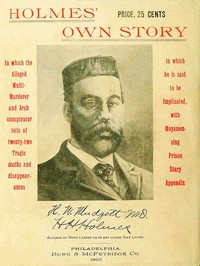
Holmes' Own Story: In Which the Alleged Multi-murderer and Arch Conspirator Tells of the Twenty-two Tragic Deaths and Disappearances in Which He Is Said to Be Implicated, With Moyamensing Prison Diary Appendix
Written by Herman W. Mudgett
Chaptra reads alongside you — AI insights, chapter breakdowns and reader discussions for every book. Join free
About this book
Reading guide
Themes, characters and key ideas in Holmes' Own Story: In Which the Alleged Multi-murderer and Arch Conspirator Tells of the Twenty-two Tragic Deaths and Disappearances in Which He Is Said to Be Implicated, With Moyamensing Prison Diary Appendix, written by Chaptra AI.
- about 8 hours
- advanced
- dark
- chilling
- psychological
Herman W. Mudgett, better known as H.H. Holmes, pens a chilling pseudo-autobiographical account in "Holmes' Own Story," attempting to clear his name amidst public accusations of being America's first modern serial killer. Narrating from prison, Mudgett recounts his early life, including a nascent fascination with death and medicine, and meticulously details his interactions with key figures like the Pitezel family and Minnie Williams, whose tragic ends are central to his alleged crimes. This self-serving narrative seeks to present a version of events that absolves him of guilt, offering a disturbing glimpse into the mind of a man entangled in a web of deceit, manipulation, and probable murder, all while maintaining an unsettling veneer of innocence.
“"It is not to excuse myself, but to clear my name from the infamy which attaches to it, that I have undertaken to write this story."”
Key themes
- Unreliable Narration and Self-Deception
- This is the overarching theme of the entire book. Mudgett's narrative is a masterclass in unreliable narration, where he systematically presents events and motives in a way that absolves him of guilt. He distorts facts, rationalizes heinous acts, and consistently portrays himself as a victim of circumstance or public misunderstanding, rather than a perpetrator. This self-deception is crucial to his attempt to 'clear his name.'
- The Nature of Evil and Psychopathy
- While Mudgett attempts to portray himself as innocent, his narrative inadvertently provides a chilling insight into the mind of a probable psychopath. The detached tone, lack of genuine empathy, elaborate rationalizations, and focus on self-preservation, even when discussing horrific events, offer a disturbing look at how a person can commit atrocities while maintaining an internal justification for their actions. The book explores how individuals can rationalize profoundly immoral behavior.
- Media Sensationalism and Public Opinion
- A primary motivation for Mudgett writing his story is to counter what he perceives as unfair and sensationalized media portrayals. The book implicitly and explicitly comments on the power of the press in shaping public opinion and convicting individuals in the court of public perception long before legal proceedings conclude. It's a historical document reflecting the rise of 'yellow journalism' and its impact on high-profile criminal cases.
Worth discussing
How does Mudgett's narrative attempt to manipulate the reader's perception of his guilt or innocence? Provide specific examples of his rationalizations.
Chapter-by-chapter breakdowns, character arcs and the full thematic analysis come with a free account.
Discussions
No one has started one yet
Questions this book opens up
No discussions yet
Be the first to start a discussion about this book!
Sign up to start the discussionReviews
No reviews yet
Be the first to review this book!