
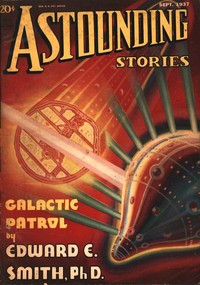
Galactic Patrol
Written by E. E. (Edward Elmer) Smith
Chaptra reads alongside you — AI insights, chapter breakdowns and reader discussions for every book. Join free
About this book
Read it with a club
Chaptra's science fiction and fantasy clubs — small groups reading the same books and talking as they go.


Sci-Fi That Got It Right (And Wrong)
Science fiction and fantasy
- 4 members
- 4 discussions
- Active Sep 11
Old science fiction, read against what actually happened. We keep score. This is a Chaptra house club — set up and moderated by us to get the conversation going. Open to everyone; jump in anywhere.
Read Galactic Patrol alongside people who are reading it too.
Also here: The Dragon Problem, Hard SF vs Soft SF
Chaptra Prime — paid clubs, every club feature, and unlimited reading support, for $5 a month or $60 once.
See PrimeReading guide
Themes, characters and key ideas in Galactic Patrol, written by Chaptra AI.
- about 9 hours
- intermediate
- epic
- adventurous
- heroic
E. E. Smith's "Galactic Patrol" plunges readers into a grand cosmic conflict as Kimball Kinnison, a newly minted Lensman, embarks on his destiny to protect civilization. Graduating from the prestigious Galactic Patrol academy, Kinnison receives the mysterious Lens, a device granting incredible mental powers and immense responsibility. He quickly finds himself embroiled in a galaxy-spanning war against the enigmatic and ruthless organization known as Boskone, a shadowy empire intent on galactic domination. Teaming up with brilliant alien Lensmen, Kinnison must develop his unique abilities, navigate treacherous space battles, and uncover the true nature of the threat to uphold justice across the vast interstellar frontier.
“"The Lens is not a weapon, Kinnison. It is a tool. A tool for justice, for wisdom, and for peace."”
Key themes
- Good vs. Evil
- This is the foundational theme of the entire Lensman series. "Galactic Patrol" establishes a clear, cosmic struggle between the benevolent forces of the Galactic Patrol (representing civilization, order, and justice) and the malevolent empire of Boskone (representing chaos, tyranny, and destruction). The Lens itself symbolizes the force for good, while Boskone embodies unmitigated evil. The narrative leaves little room for moral ambiguity, portraying a universe where these two forces are locked in an eternal, high-stakes conflict.
- Responsibility of Power
- The Lens is not merely a device; it is a symbol of immense power and the profound responsibility that comes with it. Lensmen are chosen not just for their intelligence or bravery, but for their inherent moral fiber and capacity for self-control. The narrative emphasizes that the power granted by the Lens is a tool for justice and protection, not for personal gain or arbitrary use. Kinnison's journey is partly about learning to wield this power ethically and effectively.
- Technological Advancement and its Implications
- Smith's universe is defined by its incredible technological leaps, from faster-than-light travel to advanced weaponry and communication. The novel revels in describing these innovations, often in great detail, showcasing both the marvels they enable (galactic civilization, the Lens) and the destructive potential they unleash (Boskonian super-weapons, massive space battles). It explores how technology shapes society, warfare, and the very concept of heroism.
Worth discussing
How does the concept of the Lens elevate the traditional hero archetype, and what responsibilities does it imply beyond mere power?
Chapter-by-chapter breakdowns, character arcs and the full thematic analysis come with a free account.
Discussions
No one has started one yet
Questions this book opens up
No discussions yet
Be the first to start a discussion about this book!
Sign up to start the discussionReviews
No reviews yet
Be the first to review this book!