
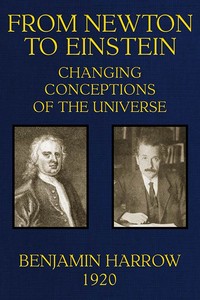
From Newton to Einstein: Changing Conceptions of the Universe
Written by Benjamin Harrow
Not rated yet — tap a star to review it
Relativity (Physics)Newton, Isaac, Sir, 1642-1727Einstein, Albert, 1879-1955Ether (Space)Gravitation
Chaptra reads alongside you — AI insights, chapter breakdowns and reader discussions for every book. Join free
About this book
"From Newton to Einstein: Changing Conceptions of the Universe" by Benjamin Harrow is a scientific publication written in the early 20th century. The book explores the significant shifts in understanding the universe, particularly focusing on the groundbreaking contributions of Isaac Newton and Albert Einstein to the fields of gravitation and physics. Harrow aims to present these complex concepts in a manner accessible to a general audience, highlighting the evolution of scientific thought from Newton's laws to Einstein's theories of relativity. The opening of the work sets the stage by establishing the importance of both Newton and Einstein in altering humanity's comprehension of the cosmos. It begins with an acknowledgment of Newton's revolutionary contributions, notably his law of gravitation, which unified terrestrial and celestial mechanics, and later transitions to Einstein's transformative theories, which redefined the nature of time and space. Harrow outlines the intellectual progression from the geocentric views of Ptolemy through the heliocentric revelations of Copernicus and the scientific bravery of Galileo, ultimately paving the way for Newton's and later Einstein's monumental achievements. The text effectively encapsulates the historical context and fundamental concepts that are central to understanding the monumental shifts in our perception of the universe.
Reading guide
Themes, characters and key ideas in From Newton to Einstein: Changing Conceptions of the Universe, written by Chaptra AI.
A reading guide for this book hasn't been written yet. Chaptra builds one the first time a reader opens it.
Chapter-by-chapter breakdowns, character arcs and the full thematic analysis come with a free account.
Discussions
No one has started one yet
No discussions yet
Be the first to start a discussion about this book!
Sign up to start the discussionReviews
No reviews yet
Be the first to review this book!