
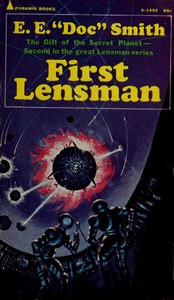
First Lensman
Written by E. E. (Edward Elmer) Smith
Chaptra reads alongside you — AI insights, chapter breakdowns and reader discussions for every book. Join free
About this book
Read it with a club
Chaptra's science fiction and fantasy clubs — small groups reading the same books and talking as they go.


Sci-Fi That Got It Right (And Wrong)
Science fiction and fantasy
- 4 members
- 4 discussions
- Active Sep 11
Old science fiction, read against what actually happened. We keep score. This is a Chaptra house club — set up and moderated by us to get the conversation going. Open to everyone; jump in anywhere.
Read First Lensman alongside people who are reading it too.
Also here: The Dragon Problem, Hard SF vs Soft SF
Chaptra Prime — paid clubs, every club feature, and unlimited reading support, for $5 a month or $60 once.
See PrimeReading guide
Themes, characters and key ideas in First Lensman, written by Chaptra AI.
- about 8 hours
- intermediate
- epic
- adventurous
- heroic
E. E. Smith's "First Lensman" chronicles the epic origin story of the Galactic Patrol and its indispensable psychic tool, the Lens, in a universe plagued by an ancient struggle between benevolent Arisians and malevolent Eddorians. The narrative introduces Virgil Samms, a brilliant human, who, guided by the Arisians, becomes the first Lensman, tasked with uniting diverse civilizations against the Eddorian threat. As Samms establishes the Patrol, he navigates political intrigue, technological marvels, and the burgeoning understanding of mental powers, laying the groundwork for a galaxy-spanning defense. The novel delves into the deep backstory of these cosmic entities, revealing their millennia-long, subtle war for control over sentient life. Ultimately, it depicts the initial, crucial steps in humanity's rise to galactic prominence and its pivotal role in the grand cosmic conflict.
“"It is not enough that you be good; you must be good enough."”
Key themes
- Good vs. Evil (Cosmic Scale)
- The fundamental theme of the novel is the eternal, overarching conflict between absolute good (Arisians) and absolute evil (Eddorians). This isn't a nuanced struggle but a clear-cut, existential war for the destiny of all sentient life. The Arisians guide and protect, fostering evolution and freedom, while the Eddorians seek domination, enslavement, and the exploitation of others for their own power.
- Evolution and Potential of Intelligence
- The novel deeply explores the concept of directed evolution, specifically the Arisians' millennia-long project to cultivate species, particularly humans, to reach a pinnacle of mental and ethical development. This theme highlights the potential for sentient life to evolve beyond its current limitations, both intellectually and psychically, to confront cosmic challenges.
- Cosmic Responsibility and Leadership
- With the discovery of interstellar travel and the vastness of the galaxy, the theme of cosmic responsibility emerges. Characters like Virgil Samms are burdened with the immense task of bringing order to chaos, protecting nascent civilizations, and leading a diverse galactic alliance against an existential threat. It's about stepping up to a galactic stage and accepting the mantle of universal stewardship.
Worth discussing
How does E. E. Smith's portrayal of 'good' (Arisians) and 'evil' (Eddorians) shape the moral landscape of the universe? Is it too simplistic or effectively archetypal?
Chapter-by-chapter breakdowns, character arcs and the full thematic analysis come with a free account.
Discussions
No one has started one yet
Questions this book opens up
No discussions yet
Be the first to start a discussion about this book!
Sign up to start the discussionReviews
No reviews yet
Be the first to review this book!