
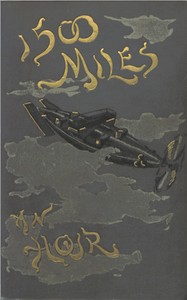
Fifteen Hundred Miles an Hour
Written by Charles Dixon
Chaptra reads alongside you — AI insights, chapter breakdowns and reader discussions for every book. Join free
About this book
Read it with a club
Chaptra's science fiction and fantasy clubs — small groups reading the same books and talking as they go.


Sci-Fi That Got It Right (And Wrong)
Science fiction and fantasy
- 4 members
- 4 discussions
- Active Sep 11
Old science fiction, read against what actually happened. We keep score. This is a Chaptra house club — set up and moderated by us to get the conversation going. Open to everyone; jump in anywhere.
Read Fifteen Hundred Miles an Hour alongside people who are reading it too.
Also here: The Dragon Problem, Hard SF vs Soft SF
Chaptra Prime — paid clubs, every club feature, and unlimited reading support, for $5 a month or $60 once.
See PrimeReading guide
Themes, characters and key ideas in Fifteen Hundred Miles an Hour, written by Chaptra AI.
- about 8 hours
- intermediate
- adventurous
- scientific
- mysterious
Charles Dixon's "Fifteen Hundred Miles an Hour" is a pioneering late 19th-century science fiction novel chronicling humanity's first audacious journey to Mars. Led by the visionary Doctor Hermann, along with his companions John Temple and engineer Harry Graham, the crew embarks in their advanced air carriage, the "Sirius." The narrative is a thrilling blend of scientific ambition and cosmic adventure, exploring themes of exploration, the relentless pursuit of knowledge, and the profound encounter with alien landscapes. From Earth's preparations to the challenges of deep space, including a fierce sandstorm and a mysterious meteorite, the story builds palpable excitement and tension towards the ultimate destination of Mars.
“"Our vessel, the Sirius, is not merely a machine, but a testament to human ingenuity, destined to bridge the celestial gap."”
Key themes
- Exploration and Discovery
- This is the central theme, driving the entire narrative. The journey from Earth to Mars is the ultimate act of exploration, pushing the boundaries of human reach and knowledge. It explores the innate human desire to venture into the unknown, to map new territories, and to understand the cosmos beyond our home planet.
- Quest for Knowledge and Scientific Advancement
- The novel is a paean to scientific progress and the relentless pursuit of understanding. Doctor Hermann's experimental designs and the very existence of the 'Sirius' underscore the belief that science can overcome any obstacle. It highlights the intellectual curiosity that fuels innovation and the desire to uncover the universe's secrets.
- Human Ambition and Resilience
- The daring journey to Mars is a testament to human ambition—the drive to achieve seemingly impossible feats. Alongside this ambition is the theme of resilience, as the crew faces and overcomes severe challenges like the sandstorm and the meteorite. It explores the courage and determination required to push beyond perceived limits.
Worth discussing
How does Dixon's depiction of space travel compare to later science fiction, and what does this reveal about late 19th-century scientific imagination?
Chapter-by-chapter breakdowns, character arcs and the full thematic analysis come with a free account.
Discussions
No one has started one yet
Questions this book opens up
No discussions yet
Be the first to start a discussion about this book!
Sign up to start the discussionReviews
No reviews yet
Be the first to review this book!