
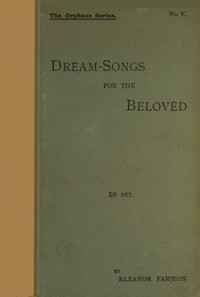
Dream-Songs for the Belovèd
Written by Eleanor Farjeon
Chaptra reads alongside you — AI insights, chapter breakdowns and reader discussions for every book. Join free
About this book
Read it with a club
Chaptra's poetry and plays clubs — small groups reading the same books and talking as they go.


Shakespeare Out Loud
Poetry and plays
- 4 members
- 4 discussions
- Active Sep 11
Plays are scripts, not novels. We read them aloud, in parts, and it changes everything. This is a Chaptra house club — set up and moderated by us to get the conversation going. Open to everyone; jump in anywhere.
Read Dream-Songs for the Belovèd alongside people who are reading it too.
Chaptra Prime — paid clubs, every club feature, and unlimited reading support, for $5 a month or $60 once.
See PrimeReading guide
Themes, characters and key ideas in Dream-Songs for the Belovèd, written by Chaptra AI.
- about 6 hours
- intermediate
- romantic
- contemplative
- lyrical
Eleanor Farjeon's "Dream-Songs for the Belovèd" is an early 20th-century collection of lyrical poetry steeped in themes of love, nature, and profound spiritual connection. Through a series of deeply emotional and often mystical verses, Farjeon explores the intricate relationship between the human heart and the natural world, addressing an unnamed 'Belovèd.' The poems delve into the interplay of silence and expression, the fleeting beauty of existence, and the enduring, transcendent power of love. Rich with evocative imagery and sensory details, the collection offers a contemplative journey through longing, devotion, and the spiritual dimensions of human affection, inviting readers to ponder the deeper currents of the universe.
“In Love's House, the silence speaks a language only hearts can hear.”
Key themes
- Love and Longing
- This is the central theme, explored through various facets: romantic longing, profound devotion, the pain of absence, and the joy of connection. Farjeon delves into both the personal and universal dimensions of love, presenting it as an essential human experience that drives spiritual and emotional growth.
- Nature as a Mirror and Source of Spirituality
- Nature is not merely a backdrop but an active participant and reflection of the speaker's inner world and spiritual beliefs. Farjeon uses natural imagery—seasons, flora, light—to symbolize emotional states, the transient nature of beauty, and the profound interconnectedness of all life, suggesting a divine presence within the natural world.
- The Transcendent and Mystical
- Farjeon's poetry frequently ventures beyond the purely physical and emotional into the realm of the mystical and transcendent. Love is often depicted as a force that connects individuals to a larger, spiritual universe, suggesting that human relationships are echoes of a divine order. The poems explore the interplay between visible reality and unseen spiritual truths.
Worth discussing
How does Farjeon use nature imagery to explore the complexities of human love and emotion?
Chapter-by-chapter breakdowns, character arcs and the full thematic analysis come with a free account.
Discussions
No one has started one yet
Questions this book opens up
No discussions yet
Be the first to start a discussion about this book!
Sign up to start the discussionReviews
No reviews yet
Be the first to review this book!