
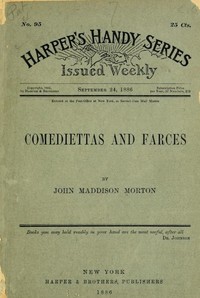
Comediettas and Farces
Written by John Maddison Morton
Chaptra reads alongside you — AI insights, chapter breakdowns and reader discussions for every book. Join free
About this book
Read it with a club
Chaptra's poetry and plays clubs — small groups reading the same books and talking as they go.


Shakespeare Out Loud
Poetry and plays
- 4 members
- 4 discussions
- Active Sep 11
Plays are scripts, not novels. We read them aloud, in parts, and it changes everything. This is a Chaptra house club — set up and moderated by us to get the conversation going. Open to everyone; jump in anywhere.
Read Comediettas and Farces alongside people who are reading it too.
Chaptra Prime — paid clubs, every club feature, and unlimited reading support, for $5 a month or $60 once.
See PrimeReading guide
Themes, characters and key ideas in Comediettas and Farces, written by Chaptra AI.
- about 10 hours
- intermediate
- humorous
- lighthearted
- chaotic
John Maddison Morton's "Comediettas and Farces" is a collection of short, lighthearted plays characteristic of Victorian-era popular theatre. These works primarily focus on generating laughter through rapid-fire dialogue, physical comedy, mistaken identities, improbable coincidences, and cleverly constructed plots. The plays often satirize social conventions, domestic life, and human follies, providing an escapist and entertaining theatrical experience for contemporary audiences. As a master of the genre, Morton's collection exemplifies the structure and comedic mechanisms that defined British farce.
“"Confusion worse confounded! My dear sir, you've mistaken me for someone else entirely!"”
Key themes
- Deception and Mistaken Identity
- This is the cornerstone of farce. Morton's plays thrive on characters intentionally deceiving others or being mistaken for someone else, leading to a cascade of misunderstandings and hilarious complications. The theme explores how easily appearances can be manipulated and how fragile social order can be when truths are obscured.
- Social Conventions and Hypocrisy
- While not deeply critical, Morton's farces often satirize the rigid social conventions and polite hypocrisy of Victorian society. Characters frequently uphold outward appearances while secretly engaging in behavior that contradicts their public persona, highlighting the gap between societal expectations and individual desires.
- The Chaos of Domestic Life
- Many of Morton's farces are set within the domestic sphere, transforming seemingly ordinary homes into battlegrounds of misunderstanding and frantic activity. The theme explores the inherent chaos and comedic potential within family dynamics, marital relationships, and the everyday struggles of cohabitation.
Worth discussing
How do Morton's farces use mistaken identity and deception to create comedic effect? What are the limits of this comedic device?
Chapter-by-chapter breakdowns, character arcs and the full thematic analysis come with a free account.
Discussions
No one has started one yet
Questions this book opens up
No discussions yet
Be the first to start a discussion about this book!
Sign up to start the discussionReviews
No reviews yet
Be the first to review this book!