
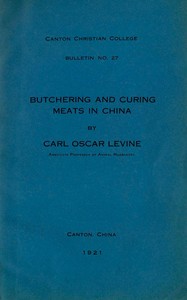
Butchering and curing meats in China
Written by Carl Oscar Levine
Chaptra reads alongside you — AI insights, chapter breakdowns and reader discussions for every book. Join free
About this book
Reading guide
Themes, characters and key ideas in Butchering and curing meats in China, written by Chaptra AI.
- about 6 hours
- intermediate
- informative
- practical
- instructive
Carl Oscar Levine's "Butchering and Curing Meats in China" is an early 20th-century scientific guide detailing traditional and modern methods of meat processing and preservation in China. The book provides practical instructions on selecting, slaughtering, dressing, and curing various meats like pork, beef, mutton, and poultry, tailored to the specific regional context. It serves as an educational resource, bridging American and Chinese techniques to promote effective meat preservation. Levine's work reflects the cultural significance of meat preparation and aims to equip agricultural students and the general public with essential knowledge for food security and culinary practices.
“The proper selection of an animal for slaughter is the first step towards quality meat.”
Key themes
- Food Preservation and Safety
- This theme explores the critical importance of preserving meat to ensure food security, prevent spoilage, and maintain public health. The book details various techniques, both traditional and scientific, emphasizing methods like salting, smoking, and proper handling to extend the shelf life of perishable meats. It underscores the practical challenges faced in an era without widespread refrigeration and the ingenuity required to overcome them.
- Cross-Cultural Agricultural Exchange
- The book highlights the exchange and comparison of meat processing techniques between Chinese and American methods. It demonstrates an early 20th-century effort to synthesize diverse knowledge systems to achieve practical outcomes. This theme reflects a broader historical trend of global knowledge transfer in agricultural science and technology, showing how different cultural approaches can inform and improve each other.
- Practical Education and Knowledge Dissemination
- Levine's work functions primarily as an educational resource, aiming to disseminate practical knowledge to agricultural students and the general public. This theme underscores the importance of accessible, clear instruction in vital skills. It reflects a belief in the power of education to improve daily life, public health, and economic efficiency through the application of scientific principles and best practices.
Worth discussing
How do historical meat preservation techniques compare to modern industrial methods?
Chapter-by-chapter breakdowns, character arcs and the full thematic analysis come with a free account.
Discussions
No one has started one yet
Questions this book opens up
No discussions yet
Be the first to start a discussion about this book!
Sign up to start the discussionReviews
No reviews yet
Be the first to review this book!