
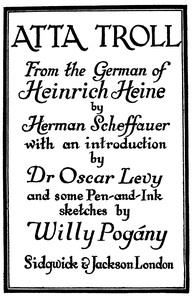
Atta Troll
Written by Heinrich Heine
Chaptra reads alongside you — AI insights, chapter breakdowns and reader discussions for every book. Join free
About this book
Reading guide
Themes, characters and key ideas in Atta Troll, written by Chaptra AI.
- about 8 hours
- advanced
- satirical
- melancholic
- humorous
Heinrich Heine's "Atta Troll" is a lyrical and satirical poem from the early 19th century, following the titular dancing bear who escapes human captivity to reclaim his wild freedom. Through Atta Troll's rebellion and the narrator's witty observations, Heine critiques the social and political landscape of his time, particularly the hypocrisy of the bourgeoisie and the limitations of both extreme romanticism and philistine realism. The poem masterfully intertwines themes of freedom, social justice, and the artist's role, presenting a complex tapestry of humor, pathos, and profound philosophical inquiry. It serves as a sharp commentary on humanity's arrogance and the struggle against oppressive forces, all delivered with Heine's characteristic irony and lyrical brilliance.
“Atta Troll, ein Bär, der tanzt, / Und doch ein Freiheitsheld, ein Märtyrer!”
Key themes
- Freedom vs. Captivity
- This is the central theme, explored through Atta Troll's literal escape from human bondage and his metaphorical yearning for a world free from oppression. It critiques political and social unfreedom, contrasting the wild, untamed spirit with the constraints of 'civilized' society.
- Social and Political Satire
- Heine uses the poem to launch a scathing critique of 19th-century German society, targeting the aristocracy, the emerging bourgeoisie (philistinism), and various political and philosophical figures and movements. He exposes hypocrisy, superficiality, and the stagnation of traditional institutions.
- Romanticism vs. Realism/Rationalism
- Heine navigates a complex relationship with Romanticism. While employing romantic settings and themes (nature, yearning for the ideal), he simultaneously satirizes its excesses, sentimentality, and detachment from social realities. He critiques both overly abstract romanticism and dry, uninspired rationalism, advocating for a balanced, engaged perspective.
Worth discussing
How does Heine use Atta Troll as an allegory for the common people or revolutionary ideals, and what is the significance of his eventual fate?
Chapter-by-chapter breakdowns, character arcs and the full thematic analysis come with a free account.
Discussions
No one has started one yet
Questions this book opens up
No discussions yet
Be the first to start a discussion about this book!
Sign up to start the discussionReviews
No reviews yet
Be the first to review this book!