
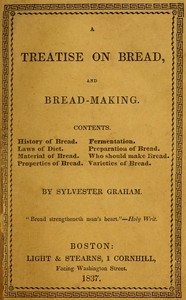
A Treatise on Bread, and Bread-making
Written by Sylvester Graham
Chaptra reads alongside you — AI insights, chapter breakdowns and reader discussions for every book. Join free
About this book
Reading guide
Themes, characters and key ideas in A Treatise on Bread, and Bread-making, written by Chaptra AI.
- about 10 hours
- advanced
- informative
- prescriptive
- didactic
Sylvester Graham's "A Treatise on Bread, and Bread-making" is a foundational text in 19th-century American health reform, passionately advocating for the consumption of whole-grain bread as essential for physical health and moral rectitude. Graham meticulously dissects the process of bread-making, from the nature of wheat to fermentation and baking, condemning the prevalent use of refined white flour and artificial additives as detrimental to human well-being. The treatise argues that a return to 'natural' bread, made from unbolted flour, is crucial for combating disease and moral decay, thereby laying the groundwork for the modern whole-foods movement.
“"It is not merely the staff of life, but the staff of health, and the staff of virtue, when made in accordance with the principles of nature."”
Key themes
- The Purity of Whole Grains vs. the Corruption of Refined Flour
- This is the central thesis of Graham's work. He argues that the natural, unbolted flour, containing all parts of the wheat kernel (bran, germ, and endosperm), is inherently superior and essential for human health. Conversely, refined white flour, stripped of its most nutritious components, is presented as an artificial, 'corrupted' product that leads to disease and moral weakness. This theme reflects a broader 19th-century concern with 'natural' living versus the perceived evils of industrial processing.
- Diet as a Foundation for Health and Morality
- Graham intertwines physical health with moral and spiritual well-being. He posits that proper diet, specifically the consumption of pure, whole-grain bread, is not merely a matter of physical sustenance but a crucial determinant of one's character, self-control, and overall virtue. Eating 'unnatural' or 'corrupted' foods is presented as leading not only to physical ailments but also to moral degradation and a weakening of the will.
- Critique of Industrialization and Food Adulteration
- Graham's treatise is a direct response to the changing landscape of food production in the 19th century, particularly the rise of commercial bakeries and industrial milling. He views these developments with suspicion, arguing that they prioritize profit over public health, leading to widespread adulteration of food with harmful substances and the degradation of natural ingredients. He advocates for a return to artisanal, home-based production, where quality and purity can be controlled.
Worth discussing
To what extent do Graham's arguments about whole grains and refined flour remain relevant today?
Chapter-by-chapter breakdowns, character arcs and the full thematic analysis come with a free account.
Discussions
No one has started one yet
Questions this book opens up
No discussions yet
Be the first to start a discussion about this book!
Sign up to start the discussionReviews
No reviews yet
Be the first to review this book!