
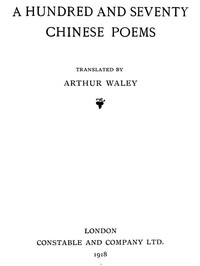
A Hundred and Seventy Chinese Poems
Written by Unknown author
Chaptra reads alongside you — AI insights, chapter breakdowns and reader discussions for every book. Join free
About this book
Read it with a club
Chaptra's poetry and plays clubs — small groups reading the same books and talking as they go.


Shakespeare Out Loud
Poetry and plays
- 4 members
- 4 discussions
- Active Sep 11
Plays are scripts, not novels. We read them aloud, in parts, and it changes everything. This is a Chaptra house club — set up and moderated by us to get the conversation going. Open to everyone; jump in anywhere.
Read A Hundred and Seventy Chinese Poems alongside people who are reading it too.
Chaptra Prime — paid clubs, every club feature, and unlimited reading support, for $5 a month or $60 once.
See PrimeReading guide
Themes, characters and key ideas in A Hundred and Seventy Chinese Poems, written by Chaptra AI.
- about 10 hours
- intermediate
- contemplative
- melancholic
- serene
Arthur Waley's "A Hundred and Seventy Chinese Poems" is a landmark collection that introduced classical Chinese poetry, primarily from the Tang Dynasty, to a wide English-speaking audience. Published in 1918, it showcases a diverse range of poetic voices exploring universal themes of nature, friendship, transience, duty, and the human condition. Waley's translations are celebrated for their clarity, accessibility, and poetic sensibility, making these ancient works resonate deeply with modern readers. The anthology served as a crucial bridge between Eastern and Western literary traditions, profoundly influencing modernist poets and shaping Western perceptions of Chinese culture.
“Before my bed there is a patch of moonlight. / I wonder if it is frost on the ground?”
Key themes
- Nature and the Cosmos
- Nature is not merely a backdrop but an active participant and source of profound insight. Mountains, rivers, trees, birds, and celestial bodies are imbued with symbolic meaning, reflecting human emotions, the cycle of life, and the vastness of the universe. It often serves as a refuge from the human world or a mirror for contemplation.
- Transience and Impermanence
- A pervasive theme, reflecting the Buddhist and Taoist understanding of the fleeting nature of life, beauty, and human endeavors. Poets often lament the passage of time, the fading of youth, the loss of friends, and the impermanence of worldly glory, contrasting it with the enduring cycles of nature.
- Friendship and Solitude
- The collection beautifully explores the profound value of friendship, particularly among educated men and fellow poets, often celebrated through shared wine, poetry, and quiet contemplation. Conversely, it also delves into the depths of solitude, often experienced by exiles or those seeking spiritual retreat, which can be both a burden and a source of profound self-discovery.
Worth discussing
How do Waley's translations balance literal accuracy with poetic beauty and accessibility for a Western audience?
Chapter-by-chapter breakdowns, character arcs and the full thematic analysis come with a free account.
Discussions
No one has started one yet
Questions this book opens up
No discussions yet
Be the first to start a discussion about this book!
Sign up to start the discussionReviews
No reviews yet
Be the first to review this book!