
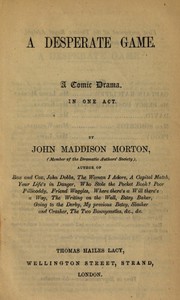
A Desperate Game: A Comic Drama in One Act
Written by John Maddison Morton
Chaptra reads alongside you — AI insights, chapter breakdowns and reader discussions for every book. Join free
About this book
Reading guide
Themes, characters and key ideas in A Desperate Game: A Comic Drama in One Act, written by Chaptra AI.
- about 1 hours
- beginner
- Humorous
- Romantic
- Lighthearted
John Maddison Morton's "A Desperate Game: A Comic Drama in One Act" is a quintessential Victorian farce, revolving around a night of escalating comedic chaos. Captain Ratcliffe, a charming but deceitful rogue, attempts to infiltrate Mrs. Somerton's home under disguise to steal her fifteen thousand pounds. His elaborate plan is continually thwarted and complicated by the unexpected arrival of Mrs. Somerton's bumbling fiancé, Mr. Percy Postlethwaite, who also tries to surprise her. The play masterfully uses mistaken identities, rapid-fire misunderstandings, and physical comedy to build tension and laughter, ultimately resolving into a romantic comedy where love unexpectedly triumphs over avarice and deception.
“"A desperate game, indeed, when one's fortune hangs by a thread of disguise!"”
Key themes
- Deception and Disguise
- The entire premise of the play hinges on Captain Ratcliffe's elaborate disguise and his sustained deception. This theme is explored through his constant need to improvise and maintain his false identity, as well as the layers of misunderstanding it creates with Mr. Postlethwaite. It highlights how easily appearances can be manipulated and how perception can be skewed.
- Love and Romance
- Initially, the play presents a cynical view of romance, with Ratcliffe's mercenary intentions and Postlethwaite's superficial courtship. However, as the chaos unfolds, a genuine romantic connection blossoms between Ratcliffe and Mrs. Somerton, transforming the play into a delightful romantic comedy. It suggests that love can arise in the most unexpected circumstances and can even redeem a person's character.
- Social Conventions and Appearances
- The play lightly satirizes Victorian social norms regarding wealth, marriage, and decorum. Postlethwaite embodies the absurdity of superficial social climbing and the expectation of 'proper' behavior, while Ratcliffe's ability to navigate society through disguise highlights the fragility of these conventions. The resolution, where a 'criminal' is accepted over a 'respectable' but foolish suitor, challenges conventional notions of suitability.
Worth discussing
How does 'A Desperate Game' exemplify the characteristics of a Victorian farce, and what elements make it enduringly funny?
Chapter-by-chapter breakdowns, character arcs and the full thematic analysis come with a free account.
Discussions
No one has started one yet
Questions this book opens up
No discussions yet
Be the first to start a discussion about this book!
Sign up to start the discussionReviews
No reviews yet
Be the first to review this book!