
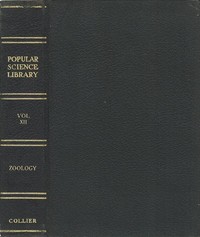
Zoölogy: The Science of Animal Life: Popular Science Library, Volume XII (of 16), P. F. Collier & Son Company, 1922
Written by Ernest Ingersoll
Chaptra reads alongside you — AI insights, chapter breakdowns and reader discussions for every book. Join free
About this book
Reading guide
Themes, characters and key ideas in Zoölogy: The Science of Animal Life: Popular Science Library, Volume XII (of 16), P. F. Collier & Son Company, 1922, written by Chaptra AI.
- about 12 hours
- advanced
- informative
- scholarly
- analytical
Ernest Ingersoll's "Zoölogy: The Science of Animal Life" is a foundational early 20th-century scientific survey that meticulously explores the vast diversity and intricate complexity of animal life, from the simplest organisms to the most advanced. The work begins with a philosophical and historical inquiry into the origins of life and the evolution of scientific thought, setting a broad context for understanding the natural world. It systematically classifies and discusses various animal groups, highlighting their unique characteristics and the profound interdependence that defines ecosystems. Ingersoll emphasizes the fundamental biological processes, such as cellular structure and photosynthesis, as cornerstones for comprehending life's essence, bridging ancient philosophical questions with emerging scientific understanding of the era.
“The quest to understand life's origin is as old as humanity's capacity for wonder, evolving from myth to the rigorous scrutiny of science.”
Key themes
- Diversity and Complexity of Animal Life
- This is the overarching theme of the entire work, as Ingersoll provides an extensive survey of the animal kingdom. He meticulously details the vast array of species, their unique adaptations, classifications, and biological structures, emphasizing the incredible range of forms and functions life has taken. This theme celebrates the richness of biodiversity.
- The Origin and Nature of Life
- This theme is central to the book's opening, where Ingersoll explores humanity's historical and scientific quest to understand how life began. He delves into speculative theories like spontaneous generation and meteoric origins, contrasting them with the emerging scientific focus on cellular biology and biochemical processes as foundational to life. It frames the entire survey of animal life within the larger, enduring mystery of existence.
- Interdependence within Ecosystems
- Ingersoll highlights how different species are connected and rely on one another, as well as on their environment, for survival. This theme prefigures modern ecological concepts, demonstrating an early understanding of food webs, symbiotic relationships, and the delicate balance of nature. It moves beyond individual species to consider the broader biological community.
Worth discussing
How does Ingersoll's approach to discussing the 'origin of life' reflect the scientific understanding and debates of the early 20th century?
Chapter-by-chapter breakdowns, character arcs and the full thematic analysis come with a free account.
Discussions
No one has started one yet
Questions this book opens up
No discussions yet
Be the first to start a discussion about this book!
Sign up to start the discussionReviews
No reviews yet
Be the first to review this book!