
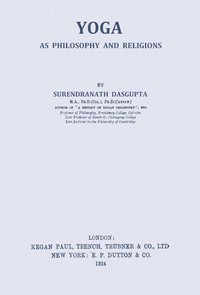
Yoga as philosophy and religion
Written by Surendranath Dasgupta
Chaptra reads alongside you — AI insights, chapter breakdowns and reader discussions for every book. Join free
About this book
Reading guide
Themes, characters and key ideas in Yoga as philosophy and religion, written by Chaptra AI.
- about 25 hours
- advanced
- scholarly
- analytical
- profound
Surendranath Dasgupta's "Yoga as Philosophy and Religion" offers a seminal, early 20th-century scholarly deep dive into the intellectual foundations of Yoga, transcending its common perception as mere physical exercise. The work meticulously analyzes Patañjali's Yoga-sūtra and its classical commentaries, illuminating Yoga's profound philosophical and religious dimensions. Dasgupta systematically explicates core doctrines, including the metaphysics of Purusha (spirit) and Prakṛti (matter), the dynamic interplay of the three Gunas (sattva, rajas, tamas), and the ethical framework leading to spiritual liberation. It positions Yoga as a sophisticated system of thought, exploring the nature of reality, consciousness, and the path to ultimate freedom, appealing to those seeking a rigorous academic understanding of this ancient tradition.
“Yoga, in its profoundest sense, is not merely a system of physical culture but a systematic discipline of the mind, rooted in a precise metaphysical understanding of reality.”
Key themes
- The Dualism of Purusha and Prakṛti
- This theme explores the core metaphysical doctrine of Yoga, which posits two ultimate, distinct realities: Purusha (pure consciousness, spirit) and Prakṛti (primordial matter, nature). Dasgupta meticulously explains how Purusha is the eternal, unchanging witness, while Prakṛti is the dynamic, evolving source of all phenomena, including the mind. The suffering of existence arises from the non-discrimination between these two, leading Purusha to identify with the modifications of Prakṛti.
- The Nature of Mind and Consciousness (Chitta and Vrittis)
- Dasgupta dedicates significant attention to the Yogic understanding of the mind (Chitta) and its modifications (Vrittis). This theme explores how the mind is viewed as a subtle product of Prakṛti, constantly fluctuating with thoughts, emotions, and perceptions. The central aim of Yoga, as he explains, is 'Chitta Vritti Nirodhah' – the cessation of these mental modifications – to reveal the pure consciousness of Purusha.
- Ethics and Spiritual Discipline (Ashtanga Yoga)
- The book explores the practical and ethical dimensions of Yoga through the framework of Ashtanga Yoga, Patañjali's eight-limbed path. Dasgupta elucidates the Yamas (moral restraints like non-violence, truthfulness) and Niyamas (observances like contentment, self-study) as foundational ethical precepts. He explains how these moral disciplines are not merely rules but essential steps that purify the mind and prepare the practitioner for deeper stages of concentration, meditation, and ultimately, liberation.
Worth discussing
How does Dasgupta's analysis challenge or expand upon common contemporary understandings of Yoga?
Chapter-by-chapter breakdowns, character arcs and the full thematic analysis come with a free account.
Discussions
No one has started one yet
Questions this book opens up
No discussions yet
Be the first to start a discussion about this book!
Sign up to start the discussionReviews
No reviews yet
Be the first to review this book!