
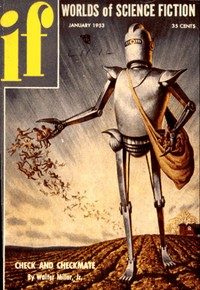
Ye of Little Faith
Written by Rog Phillips
Chaptra reads alongside you — AI insights, chapter breakdowns and reader discussions for every book. Join free
About this book
Reading guide
Themes, characters and key ideas in Ye of Little Faith, written by Chaptra AI.
- about 8 hours
- intermediate
- mysterious
- philosophical
- existential
Rog Phillips' "Ye of Little Faith," an early 1950s science fiction novel, explores the perilous intersection of belief, logic, and reality. The story begins with Professor Martin Grant's theoretical premise that reality might not be fundamentally logical, a concept that tragically leads to the mysterious disappearances of his friends and colleagues who engage with it. His son, Fred Grant, is left to grapple with the aftermath, embarking on a determined quest to uncover the mechanism behind these vanishments. Fred's journey delves deep into the philosophical implications of his father's theory, challenging his own perceptions and ultimately confronting the paradoxical nature of existence itself. The novel culminates in a profound exploration of human understanding and the potent, perhaps dangerous, impact of belief on the fabric of reality.
“"Perhaps the greatest illusion is not what we see, but that what we see is fixed and immutable."”
Key themes
- Belief and Reality
- This is the central pillar of the novel, exploring the radical idea that what individuals believe, or even intellectually grapple with, can directly influence or reshape the fabric of reality itself. It challenges the notion of an objective, independently existing reality, suggesting a profound subjectivity where consciousness might be a co-creator of existence. The disappearances serve as a terrifying manifestation of this theme, implying that a shift in one's fundamental understanding or acceptance of reality can lead to one's literal unmaking.
- The Limits of Human Understanding
- The novel probes the boundaries of human intellect and perception, suggesting that there are truths about the universe that our minds are simply not equipped to comprehend, or perhaps are actively prevented from comprehending by the very structure of our consciousness. Martin Grant's theory is 'unexplainable' not just because it's novel, but because it challenges the fundamental logical frameworks upon which human understanding is built. The disappearances occur precisely when individuals attempt to push past these inherent limits.
- The Impact of Ideas and Thought
- Beyond mere belief, the novel explores the profound and potentially dangerous power of abstract ideas and theoretical thought. Martin Grant's theory is not a physical weapon, yet its mere conceptual existence and the act of engaging with it intellectually lead to dire, existential consequences. This theme highlights the responsibility that comes with intellectual exploration and the unforeseen impacts that even the most abstract concepts can have on the tangible world and human lives.
Worth discussing
How does Martin Grant's theory challenge our conventional understanding of objective reality and the scientific method?
Chapter-by-chapter breakdowns, character arcs and the full thematic analysis come with a free account.
Discussions
No one has started one yet
Questions this book opens up
No discussions yet
Be the first to start a discussion about this book!
Sign up to start the discussionReviews
No reviews yet
Be the first to review this book!