
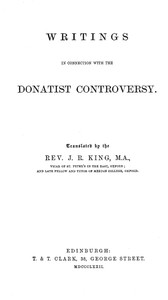
Writings in Connection with the Donatist Controversy
Written by Saint Augustine
Chaptra reads alongside you — AI insights, chapter breakdowns and reader discussions for every book. Join free
About this book
Reading guide
Themes, characters and key ideas in Writings in Connection with the Donatist Controversy, written by Chaptra AI.
- about 30 hours
- advanced
- analytical
- didactic
- polemical
Augustine's "Writings in Connection with the Donatist Controversy" is a foundational theological work from the early 5th century, meticulously dissecting the Donatist schism within the early Christian church. The text primarily defends the Catholic Church's stance on the validity of sacraments, particularly baptism, asserting their efficacy independent of the minister's personal moral standing or perceived purity. Augustine grounds his arguments in the importance of ecclesial unity and catholicity, tracing the schism's origins to the Diocletianic persecution and a subsequent dispute over episcopal consecration. He systematically refutes Donatist claims, notably reinterpreting the authority of Cyprian to support Catholic doctrine rather than Donatist separatism, laying a robust theological framework for understanding church unity and sacramental theology.
“It is therefore Christ who baptizes, not the minister.”
Key themes
- Ecclesial Unity
- This is the overarching theme, as Augustine vehemently argues for the paramount importance of maintaining the unity of the Catholic Church. He sees schism as a grave sin, tearing apart the Body of Christ. He emphasizes that the Church, though imperfect on earth, is one and universal, a 'mixed body' of both righteous and sinful members destined for divine judgment, not human separation.
- Validity of Sacraments (especially Baptism)
- Central to the controversy, Augustine articulates a definitive theology of sacraments, arguing that their efficacy derives from Christ's institution (*ex opere operato*) rather than the moral standing or purity of the minister. This principle ensures that sacraments are objective acts of God's grace, not dependent on human worthiness, thereby preventing schism based on perceived clerical impurity.
- Nature of Schism and Heresy
- Augustine provides a clear distinction between schism (a break in unity, often over discipline or authority) and heresy (a departure from core doctrine). He consistently condemns schism as a grave sin against charity and the Body of Christ, even when the schismatics hold correct theological beliefs. He argues that schismatics, by separating themselves, cut themselves off from the full flow of grace within the universal Church.
Worth discussing
How does Augustine define 'church unity,' and what are its implications for modern ecumenical movements?
Chapter-by-chapter breakdowns, character arcs and the full thematic analysis come with a free account.
Discussions
No one has started one yet
Questions this book opens up
No discussions yet
Be the first to start a discussion about this book!
Sign up to start the discussionReviews
No reviews yet
Be the first to review this book!