
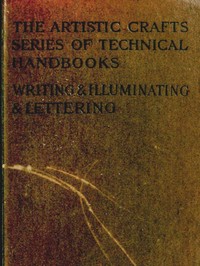
Writing & Illuminating, & Lettering
Written by Edward Johnston
Chaptra reads alongside you — AI insights, chapter breakdowns and reader discussions for every book. Join free
About this book
Reading guide
Themes, characters and key ideas in Writing & Illuminating, & Lettering, written by Chaptra AI.
- about 40 hours
- advanced
- Instructive
- Meticulous
- Reverent
Edward Johnston's "Writing & Illuminating, & Lettering" is a seminal early 20th-century technical handbook that comprehensively guides readers through the foundational arts of calligraphy, illumination, and letter forms. Emphasizing the intrinsic connection between meticulous craftsmanship and thoughtful design, the book provides practical techniques for achieving legible and beautiful writing while meticulously detailing the historical evolution of various lettering styles. Johnston asserts the profound artistic and educational value inherent in these practices, advocating for the mastery of proper instruments and formal techniques. The work serves as both a practical manual and a philosophical treatise, encouraging a deep appreciation for the aesthetic and expressive potential of written communication informed by historical precedent.
“"The aim of all good writing is to be at once beautiful and legible."”
Key themes
- Craftsmanship and Diligence
- Johnston consistently champions the value of meticulous craftsmanship, asserting that true mastery in lettering and illumination comes through diligent practice, attention to detail, and a deep respect for materials and tools. He outlines precise techniques and encourages perseverance, framing the act of creation as a thoughtful and disciplined endeavor rather than a spontaneous one. This theme underpins all practical instruction in the book.
- Historical Continuity and Revival
- A cornerstone of Johnston's philosophy is the belief that contemporary practice must be deeply rooted in historical understanding. He meticulously traces the evolution of letterforms from ancient Roman capitals through medieval scripts, arguing that studying the methods and aesthetics of past masters provides an indispensable foundation for modern work. The book itself was instrumental in reviving calligraphy as a serious art form, bridging the gap between historical traditions and modern application.
- Legibility and Beauty
- Johnston repeatedly stresses the dual objective of all good writing: to be both beautiful and legible. He argues that these two qualities are not mutually exclusive but rather complementary, with true beauty often arising from clarity and functional design. His instruction guides the reader to create forms that are aesthetically pleasing without sacrificing their primary purpose of conveying information clearly, establishing a fundamental principle for all visual communication.
Worth discussing
How does Johnston's emphasis on historical practices inform and potentially limit or enhance modern artistic expression in lettering?
Chapter-by-chapter breakdowns, character arcs and the full thematic analysis come with a free account.
Discussions
No one has started one yet
Questions this book opens up
No discussions yet
Be the first to start a discussion about this book!
Sign up to start the discussionReviews
No reviews yet
Be the first to review this book!