
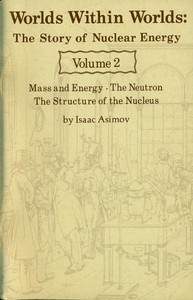
Worlds Within Worlds: The Story of Nuclear Energy, Volume 2 (of 3): Mass and Energy; The Neutron; The Structure of the Nucleus
Written by Isaac Asimov
Chaptra reads alongside you — AI insights, chapter breakdowns and reader discussions for every book. Join free
About this book
Read it with a club
Small groups reading the same books and talking as they go.


News
- 4 members
- 1,813 discussions
- Active Sep 11
Read Worlds Within Worlds: The Story of Nuclear Energy, Volume 2 (of 3): Mass and Energy; The Neutron; The Structure of the Nucleus alongside people who are reading it too.
Also here: News Bulletin, Just Joking....
Chaptra Prime — paid clubs, every club feature, and unlimited reading support, for $5 a month or $60 once.
See PrimeReading guide
Themes, characters and key ideas in Worlds Within Worlds: The Story of Nuclear Energy, Volume 2 (of 3): Mass and Energy; The Neutron; The Structure of the Nucleus, written by Chaptra AI.
- about 8 hours
- intermediate
- informative
- enlightening
- educational
Isaac Asimov's "Worlds Within Worlds: The Story of Nuclear Energy, Volume 2 (of 3)" serves as an accessible guide to the foundational scientific principles underpinning nuclear energy, written for a general audience in the early 1970s. This volume meticulously breaks down complex concepts such as Albert Einstein's revolutionary mass-energy equivalence (E=mc²), the intricate structure of the atomic nucleus, and the pivotal discovery of the neutron. Asimov masterfully weaves together historical context with clear scientific explanations, illustrating how incremental scientific advancements paved the way for understanding nuclear reactions. The book not only illuminates the immense potential for energy generation but also implicitly acknowledges the profound societal implications and challenges inherent in harnessing such power, making it a crucial bridge between advanced physics and public understanding.
“Mass and energy are but two different manifestations of the same thing.”
Key themes
- The Interconvertibility of Mass and Energy
- This theme explores Einstein's groundbreaking theory that mass and energy are not distinct entities but different forms of the same fundamental quantity, expressed by E=mc². Asimov emphasizes how this seemingly abstract concept laid the theoretical foundation for understanding the immense energy released in nuclear reactions, fundamentally altering humanity's understanding of the universe and its potential.
- The Fundamental Nature of Matter (Nuclear Structure)
- This theme delves into the discoveries that revealed the atomic nucleus to be composed of protons and neutrons. Asimov meticulously explains the experimental evidence and theoretical reasoning that led to this understanding, highlighting the journey from early, simplistic atomic models to the more refined and accurate nuclear model, which is essential for comprehending nuclear stability and reactivity.
- The Process of Scientific Discovery and Innovation
- Asimov consistently frames the scientific content within the context of how science actually progresses—through observation, hypothesis, experimentation, and the collaborative, cumulative efforts of many individuals over time. This theme underscores the human element of science, showcasing the intellectual challenges, breakthroughs, and occasional dead ends that characterize the path to new knowledge.
Worth discussing
How does Asimov's historical approach to scientific discovery enhance your understanding of nuclear energy?
Chapter-by-chapter breakdowns, character arcs and the full thematic analysis come with a free account.
Discussions
No one has started one yet
Questions this book opens up
No discussions yet
Be the first to start a discussion about this book!
Sign up to start the discussionReviews
No reviews yet
Be the first to review this book!