
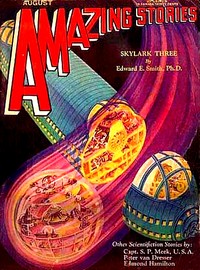
World atavism
Written by Edmond Hamilton
Chaptra reads alongside you — AI insights, chapter breakdowns and reader discussions for every book. Join free
About this book
Reading guide
Themes, characters and key ideas in World atavism, written by Chaptra AI.
- about 7 hours
- intermediate
- dark
- tense
- philosophical
Edmond Hamilton's "World Atavism" is an early 20th-century science fiction novel that plunges humanity into a dramatic crisis of evolutionary regression. The narrative follows Dr. Allan Harker and Dr. Raymond Ferson as they race to understand and halt a global catastrophe: a rapid devolution of humankind into primitive, savage forms. This terrifying backward slide is linked to the disappearance of Dr. Howard Grant, who tampered with the sun's vital 'evolutionary vibrations.' The book explores the profound fragility of civilization, the ethical boundaries of scientific discovery, and the potential for humanity's undoing, culminating in a poignant reflection on progress and despair.
“The sun, giver of life, now whispers regression, unraveling the very fabric of our being.”
Key themes
- The Fragility of Civilization
- This theme is central to the novel, illustrating how easily societal structures, cultural achievements, and even basic human intellect can collapse when fundamental biological underpinnings are disrupted. The rapid descent into savagery highlights how thin the veneer of civilization truly is.
- Evolutionary Regression and Primal Instincts
- The core speculative concept of the book, this theme directly addresses the idea that evolution is not a guaranteed linear progression. It vividly portrays humanity's rapid descent into more primitive forms, stripping away intellect and culture to reveal the raw, savage instincts that lie beneath.
- Scientific Hubris and Ethics
- The novel explores the dangerous consequences of unchecked scientific ambition. Dr. Grant's manipulation of the sun's 'evolutionary vibrations' serves as a stark warning against tampering with fundamental natural forces without fully comprehending the potential repercussions, raising questions about the moral responsibility of scientists.
Worth discussing
How does 'World Atavism' reflect early 20th-century anxieties about science, progress, and civilization?
Chapter-by-chapter breakdowns, character arcs and the full thematic analysis come with a free account.
Discussions
No one has started one yet
Questions this book opens up
No discussions yet
Be the first to start a discussion about this book!
Sign up to start the discussionReviews
No reviews yet
Be the first to review this book!