
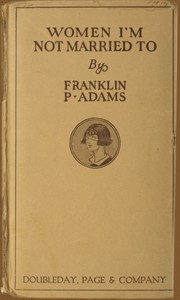
Women I'm Not Married To
Written by Franklin P. (Franklin Pierce) Adams
Chaptra reads alongside you — AI insights, chapter breakdowns and reader discussions for every book. Join free
About this book
Reading guide
Themes, characters and key ideas in Women I'm Not Married To, written by Chaptra AI.
- about 8 hours
- intermediate
- humorous
- witty
- observational
Franklin P. Adams's "Women I'm Not Married To" is a delightful early 20th-century collection of humorous character sketches, offering a witty exploration of the narrator's encounters with various women. Through light-hearted reflections, Adams delves into themes of love, beauty, attraction, and the charming eccentricities of human nature. Each chapter introduces a different woman, from the stunningly beautiful but self-absorbed Elaine to the meticulously detailed Maude, serving as a playful commentary on the complexities of relationships and the reasons why certain romantic potentials remain unfulfilled. The book provides an insightful, often ironic, glimpse into the narrator's observational mind and his candid acknowledgments of life's romantic near-misses, making it a charming and enduring work of observational humor.
“Her beauty was a fortress, impenetrable less by its strength than by her own constant patrols of its perimeter.”
Key themes
- The Nature of Attraction and Incompatibility
- This theme explores the multifaceted reasons why individuals are drawn to each other, as well as the equally varied and often subtle reasons why relationships ultimately don't lead to marriage. Adams delves into the delicate balance between superficial charm, deep personality traits, and the intangible elements that dictate romantic success or failure. The book highlights how specific quirks, even endearing ones, can become insurmountable barriers.
- Human Quirks and Eccentricities
- Adams masterfully uses the women in his sketches to explore the vast array of human eccentricities. Each character embodies a distinct, often humorous, personality quirk, from vanity to an obsession with trivia, or excessive intellectualism. The narrator's observations celebrate these individual differences while also gently pointing out how they shape personal interactions and relationship potential. It's a light-hearted study of the delightful peculiarities that make people unique.
- Humor and Irony as Social Commentary
- Adams employs a witty, ironic tone to deliver subtle social commentary on the conventions of courtship, gender roles, and societal expectations of his era. The humor is never mean-spirited but rather observational and often self-deprecating on the part of the narrator. This allows Adams to critique or reflect upon social norms and personal behaviors without being overtly didactic, making his observations more palatable and enduring.
Worth discussing
How does Adams use humor to explore the complexities of attraction and incompatibility?
Chapter-by-chapter breakdowns, character arcs and the full thematic analysis come with a free account.
Discussions
No one has started one yet
Questions this book opens up
No discussions yet
Be the first to start a discussion about this book!
Sign up to start the discussionReviews
No reviews yet
Be the first to review this book!