
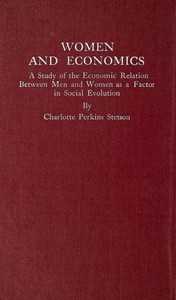
Women and Economics: A Study of the Economic Relation Between Men and Women as a Factor in Social Evolution
Written by Charlotte Perkins Gilman
Chaptra reads alongside you — AI insights, chapter breakdowns and reader discussions for every book. Join free
About this book
Reading guide
Themes, characters and key ideas in Women and Economics: A Study of the Economic Relation Between Men and Women as a Factor in Social Evolution, written by Chaptra AI.
- about 12 hours
- advanced
- Analytical
- Socio-political
- Challenging
Charlotte Perkins Gilman's "Women and Economics," published in 1898, is a seminal non-fiction work arguing that women's economic dependence on men, rather than inherent biological difference, is the primary cause of gender inequality and societal stagnation. Gilman posits that this forced dependence stunts women's individual development and hinders the evolutionary progress of the human race by perpetuating an inefficient and unnatural "sexuo-economic" relationship. She advocates for radical social reforms, including the professionalization of domestic labor and women's full participation in the public economy, to liberate women and optimize human potential. The book systematically dissects the economic roots of gender roles, offering a powerful early feminist critique of patriarchal structures.
“The woman who is economically dependent upon man for her living is not free.”
Key themes
- Economic Dependence of Women
- This is the central thesis of the book. Gilman argues that women's forced economic reliance on men, rather than inherent biological differences, is the fundamental cause of their subjugation, limited development, and the perpetuation of an unnatural social order. This dependence dictates women's roles, limits their opportunities, and distorts the natural evolutionary process of humanity.
- Gender Roles and Social Evolution
- Gilman critiques traditional gender roles as artificial constructs primarily imposed by economic dependence, rather than natural biological imperatives. She argues that these roles lead to an exaggerated "sex-distinction" in humans, hindering not only individual women's development but also the evolutionary progress of the entire human race by perpetuating inefficiency, limiting collective potential, and fostering a less adaptable society.
- Professionalization of Domestic Labor
- A radical and innovative solution proposed by Gilman, she advocates for treating domestic tasks (cooking, cleaning, childcare) as professional services performed by trained specialists, rather than individual, unpaid labor within each home. This transformation, she argues, would liberate women from individual servitude, improve efficiency, elevate the quality of these services, and allow women to participate fully in the public economy.
Worth discussing
How does Gilman's concept of "sexuo-economic" relations differ from traditional views of gender roles, and what is its continued relevance today?
Chapter-by-chapter breakdowns, character arcs and the full thematic analysis come with a free account.
Discussions
No one has started one yet
Questions this book opens up
No discussions yet
Be the first to start a discussion about this book!
Sign up to start the discussionReviews
No reviews yet
Be the first to review this book!