
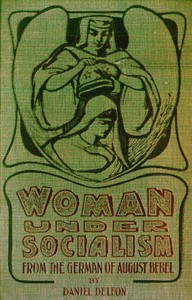
Woman under socialism
Written by August Bebel
Chaptra reads alongside you — AI insights, chapter breakdowns and reader discussions for every book. Join free
About this book
Reading guide
Themes, characters and key ideas in Woman under socialism, written by Chaptra AI.
- about 15 hours
- advanced
- analytical
- critical
- revolutionary
Woman under Socialism" by August Bebel is a seminal late 19th-century socialist feminist text that rigorously critiques the historical and contemporary subjugation of women, particularly under capitalism. Bebel argues that women's oppression is not inherent but a product of evolving social structures, intimately linked with class struggle and economic systems. He asserts that true liberation for women, encompassing equal rights, economic independence, and social dignity, can only be fully realized within a socialist society. The work meticulously traces women's roles from matriarchal societies to the industrial age, advocating for their active participation in the socialist movement as essential for universal human emancipation.
“The woman question is but one side of the great social question, and cannot be solved apart from it.”
Key themes
- Women's Oppression under Capitalism
- This is a core theme, as Bebel meticulously details how the capitalist system, through private property, economic exploitation, and patriarchal legal structures, systematically subjugates women. He argues that women are reduced to economic dependents in marriage, exploited in the workforce, and denied fundamental rights, leading to widespread social degradation.
- Socialism as the Path to Liberation
- Bebel's central thesis is that the complete emancipation of women can only be achieved through the establishment of a socialist society. He posits that by abolishing private property and creating a system based on collective ownership and cooperation, the economic and social foundations of women's oppression will be dismantled, leading to true equality.
- Historical Materialism and Gender
- Bebel applies a historical materialist framework, largely derived from Marx and Engels, to analyze the 'Woman Question.' He argues that women's status has not been static but has evolved in direct relation to changes in economic modes of production and social organization, from matriarchal societies to patriarchal capitalism. This approach demonstrates that gender roles are socially constructed, not biologically determined.
Worth discussing
How does Bebel's historical analysis of women's status from matriarchal societies to his contemporary era challenge prevailing notions of gender roles as natural or immutable?
Chapter-by-chapter breakdowns, character arcs and the full thematic analysis come with a free account.
Discussions
No one has started one yet
Questions this book opens up
No discussions yet
Be the first to start a discussion about this book!
Sign up to start the discussionReviews
No reviews yet
Be the first to review this book!