
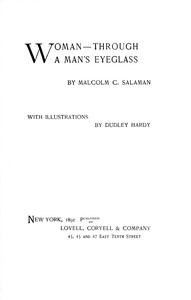
Woman—through a man's eyeglass
Written by Malcolm C. (Malcolm Charles) Salaman
Chaptra reads alongside you — AI insights, chapter breakdowns and reader discussions for every book. Join free
About this book
Reading guide
Themes, characters and key ideas in Woman—through a man's eyeglass, written by Chaptra AI.
- about 7 hours
- intermediate
- humorous
- reflective
- observational
Malcolm C. Salaman's "Woman—through a man's eyeglass" is a late 19th-century collection of social and character essays, offering a witty and reflective male perspective on various female archetypes within British society. The work blends keen observation, personal anecdote, and light satire to explore diverse expressions of womanhood, gender roles, and romantic ideals. Framed by Salaman's philosophical musings on love, marriage, and his own bachelorhood, the book proceeds as a series of vivid sketches, from the dangerously charming "Little Widow" to the idealized "My Mother" and the critically observed "Socially Ambitious Woman." Ultimately, it serves as both an amusing period piece and a thought-provoking commentary on the societal perceptions of women from a distinctly masculine viewpoint.
“It is indeed through a unique eyeglass that a man observes woman, often seeing not what is, but what he wishes to perceive, or what society has taught him to expect.”
Key themes
- Gender Roles and Expectations
- This is the overarching theme, as the book explicitly examines various female archetypes through the lens of late 19th-century British society. Salaman explores how women are expected to behave, what roles they are assigned (e.g., domestic, social climber, mother), and how they either conform to or subtly challenge these expectations. The essays reveal the societal pressures and limitations placed upon women, as well as the perceived 'ideal' femininity.
- The Male Gaze and Subjectivity
- Explicitly stated in the title, this theme explores how women are perceived and categorized from a distinctly masculine, subjective viewpoint. The book is a collection of observations and interpretations by a man, revealing more about the observer's biases, desires, and societal conditioning than perhaps the objective reality of women. It highlights the inherent subjectivity in understanding the 'other' and the power dynamics embedded in such observation.
- Social Observation and Satire
- Salaman employs keen social observation and light satire to comment on the manners, customs, and follies of late Victorian society, particularly as they relate to women. The essays are not just character studies but also critiques of social climbing, intellectual pretension, and the performance of gender roles. The satire is often witty and gentle, aiming to amuse and provoke thought rather than harshly condemn.
Worth discussing
How does Salaman's 'man's eyeglass' both enlighten and limit the reader's understanding of women in the late 19th century?
Chapter-by-chapter breakdowns, character arcs and the full thematic analysis come with a free account.
Discussions
No one has started one yet
Questions this book opens up
No discussions yet
Be the first to start a discussion about this book!
Sign up to start the discussionReviews
No reviews yet
Be the first to review this book!