
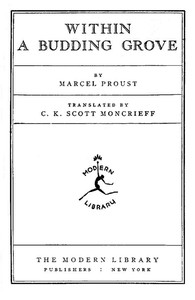
Within a Budding Grove
Written by Marcel Proust
Chaptra reads alongside you — AI insights, chapter breakdowns and reader discussions for every book. Join free
About this book
Reading guide
Themes, characters and key ideas in Within a Budding Grove, written by Chaptra AI.
- about 8 hours
- advanced
- reflective
- introspective
- melancholy
The second volume of Proust's magnum opus, "Within a Budding Grove," chronicles the narrator's transition from childhood infatuation to adolescent experiences in Parisian society and later, at the seaside resort of Balbec. It delves into his intense, often unrequited, love for Gilberte Swann, daughter of Charles Swann, and his keen observations of the social machinations and pretenses of the Parisian bourgeoisie and aristocracy. The narrative then shifts to his summer at Balbec, where he encounters a new circle of friends, including the enigmatic Albertine Simonet and the aristocratic Robert de Saint-Loup, exploring themes of budding sexuality, friendship, and the subjective nature of perception. Through intricate psychological detail and lush prose, Proust charts the narrator's emotional and intellectual awakening amidst a changing social landscape, further developing his central themes of memory, love, and the elusive nature of time.
“But our desires are like a tree that has been planted in another soil, and that has been grafted onto another stock, and that has been watered with other water, and that has grown up in another air, and that has been pruned by other hands, and that has been exposed to other winds, and that has been fertilized by other manures.”
Key themes
- Love and Desire
- The novel deeply explores the multifaceted nature of love, from the intense, often painful, infatuation of adolescence to the complexities of unrequited desire and jealousy. It delves into how love shapes perception, creating idealized images that often clash with reality, and how desire can be both a source of immense joy and profound suffering. The narrator's affections shift from Gilberte to Albertine, illustrating the transient and subjective nature of romantic attachment.
- Memory and Time
- Building on "Swann's Way," this volume continues to explore the elusive nature of memory, particularly involuntary memory, and its role in shaping identity and perception. Time is not merely a linear progression but a subjective experience, where past events continually inform and color the present. The narrator's reflections often lead him back to earlier moments, revealing how the past is never truly gone but resides within consciousness.
- Adolescence and Coming of Age
- The novel meticulously charts the narrator's psychological and emotional journey through adolescence. It captures the intensity of first loves, the confusion of sexual awakening, the pain of disillusionment, and the formation of a nascent identity. His experiences at Balbec, away from the familiar confines of his family, represent a crucial step in his transition from childhood to adulthood, marked by new friendships, desires, and social challenges.
Worth discussing
How does the narrator's perception of love and desire evolve from his infatuation with Gilberte to his encounters with Albertine?
Chapter-by-chapter breakdowns, character arcs and the full thematic analysis come with a free account.
Discussions
No one has started one yet
Questions this book opens up
No discussions yet
Be the first to start a discussion about this book!
Sign up to start the discussionReviews
No reviews yet
Be the first to review this book!