
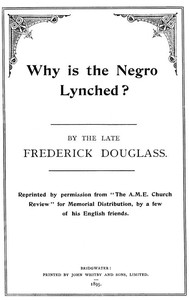
Why is the Negro Lynched?
Written by Frederick Douglass
Chaptra reads alongside you — AI insights, chapter breakdowns and reader discussions for every book. Join free
About this book
Read it with a club
Small groups reading the same books and talking as they go.


News
- 4 members
- 1,813 discussions
- Active Sep 11
Read Why is the Negro Lynched? alongside people who are reading it too.
Also here: News Bulletin, Just Joking....
Chaptra Prime — paid clubs, every club feature, and unlimited reading support, for $5 a month or $60 once.
See PrimeReading guide
Themes, characters and key ideas in Why is the Negro Lynched?, written by Chaptra AI.
- about 2 hours
- advanced
- indignant
- urgent
- authoritative
Frederick Douglass's "Why is the Negro Lynched?" is a potent late 19th-century essay that serves as a vehement denunciation of the pervasive practice of lynching and a passionate plea for racial justice in America. Douglass systematically dissects and refutes the prevailing justifications for these barbaric acts, particularly the spurious claims of assaults on white women, exposing them as fabrications rooted in deep-seated racial prejudice. He asserts the inherent humanity and dignity of Black individuals, challenging society's moral conscience to confront and dismantle the systemic racism that perpetuates such violence. Ultimately, this work stands as a powerful call for the recognition of African Americans' rights and the eradication of racist ideologies to achieve true justice.
“The crime of which the Negro is accused is not the cause of his being lynched. The crime is the pretext.”
Key themes
- Racial Injustice and Lynching
- This is the central theme, exploring the horrific practice of lynching as a tool of racial terror and systemic oppression against Black Americans. Douglass meticulously details how lynching was not a spontaneous act of justice but a calculated means to enforce white supremacy, deny Black civil rights, and maintain social control in the post-Reconstruction South. He highlights its barbarity and its profound moral stain on the nation.
- Truth vs. Prejudice and False Narratives
- Douglass's essay is a powerful exercise in exposing and dismantling the false narratives and prejudices used to justify injustice. He systematically refutes the accusations against Black men, demonstrating how lies and stereotypes are manufactured and propagated to dehumanize a group and legitimize violence against them. This theme underscores the crucial role of truth in achieving justice and the dangers of allowing prejudice to dictate public discourse and policy.
- Human Dignity and Rights
- At its core, the essay is an impassioned assertion of the fundamental human dignity and inherent rights of Black individuals. Douglass argues that despite the dehumanizing brutality of lynching and the pervasive racism, Black people are entitled to the same rights, protections, and respect as any other citizen. He emphasizes their humanity, their contributions to society, and their moral claim to justice and equality, challenging the very premise of their oppression.
Worth discussing
How does Douglass systematically dismantle the justifications for lynching, particularly the myth of the Black rapist?
Chapter-by-chapter breakdowns, character arcs and the full thematic analysis come with a free account.
Discussions
No one has started one yet
Questions this book opens up
No discussions yet
Be the first to start a discussion about this book!
Sign up to start the discussionReviews
No reviews yet
Be the first to review this book!